On Peugeot vehicles produced after 2004, the wiring of the car radio is not just about connecting wires by color. The vehicle’s multiplexed network, controlled by the BSI (intelligent service box), manages the power supply to the unit via the CAN bus. Installing an Android Auto car radio without considering this network layer leads to recurring malfunctions: no sound, non-functional steering wheel controls, or continuous rebooting.
Peugeot CAN-bus Power Supply: Why the Red ACC Wire is No Longer Enough
General wiring guides present the red wire as the +12 V permanent and the yellow wire as the +12 V after ignition (ACC). This is correct for a non-multiplexed vehicle. On a recent Peugeot, this logic no longer applies.
The BSI controls the power supply to the radio location via the CAN bus. Even if the red and yellow wires physically exist in the harness, the BSI can cut off the accessory power if the CAN bus does not receive any response from the original unit. The result: an Android Auto car radio connected correctly according to the ISO diagram, but which refuses to turn on or never turns off.
The solution involves a CAN-bus adapter box, supplied with most compatible Peugeot Android car radios or sold separately. This module intercepts the vehicle’s CAN frames (ignition, standby, off) and converts them into a power signal understandable by the aftermarket unit. To identify each wire before connection, refer to the color code for Peugeot car radio wires on the dedicated diagram.
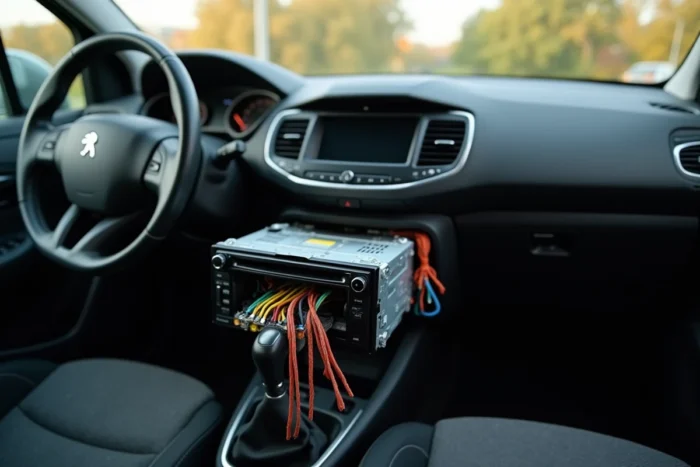
Connecting the red ACC wire of the Android unit directly to a +12 V after ignition of the vehicle, without going through the CAN adapter, prevents proper management of the gradual power on and off. The car radio remains powered continuously or does not detect the ignition cut-off, which drains the battery.
ISO Wire Correspondence and Specifics of the Peugeot Harness
The ISO connector is a standard with two housings. The black housing groups the power supply, while the brown housing contains the speaker outputs. The color code follows a standard shared by most manufacturers, but Peugeot adds its own specifics.
Power Wires (Black Housing)
- Yellow: +12 V permanent (memory of the unit, presets). This wire remains powered even when the ignition is off, directly connected to the battery
- Red: +12 V after ignition (ACC). On multiplexed Peugeots, this wire is controlled by the CAN bus via the BSI, not by a simple ignition relay
- Black: ground. To be connected to a clean ground point on the body to avoid audio interference
- Blue: antenna remote output or external amplifier control. Depending on the Peugeot model, this function may be managed by the CAN-bus
Speaker Wires (Brown Housing)
The audio outputs follow a color code in pairs. Each speaker uses a solid color positive wire and a negative wire of the same color with a black stripe or marking.
- White and white/black: left front speaker
- Gray and gray/black: right front speaker
- Green and green/black: left rear speaker
- Purple and purple/black: right rear speaker
Reversing the polarity of a speaker does not destroy it, but causes a phase opposition that degrades sound quality. The sound appears hollow, lacking bass, with a sense of distance.
Peugeot Harness to ISO Connector Adapter for an Android Auto Unit
The original Peugeot harness uses a proprietary connector that does not directly match the standard ISO format. A model-specific adapter (207, 308, 3008, 208, Expert) bridges the two formats.
This adapter serves two functions. It converts the physical Peugeot connector to a male ISO connector, and it integrates (or accompanies) the necessary CAN-bus decoder for managing power and steering wheel controls.
Choosing a generic “Peugeot/Citroën” adapter without checking compatibility with the exact model and year of the vehicle remains the most common pitfall. Harnesses vary between a 308 phase 1 and a 308 phase 2, between a 2016 Expert and a 2019 Expert. The OEM number of the original connector, visible on the vehicle’s technical sheet or on the connector itself, helps clarify any doubts.

Steering Wheel Controls and Antenna Signal: Wires Not Shown in the ISO Diagram
Beyond power and speakers, two functions complicate the wiring on Peugeot: steering wheel controls and the antenna signal.
The steering wheel controls (volume, track change, call answer) pass through the CAN bus on multiplexed models. A dedicated steering wheel interface module translates these CAN frames into analog or digital pulses that the Android Auto unit can interpret. Without this module, the steering wheel buttons remain silent after installation.
The FM antenna signal poses another problem. Some Peugeots use an amplified antenna that requires phantom power via a dedicated wire (often the blue wire of the ISO connector). If the CAN-bus adapter does not provide this voltage, radio reception is weak or nonexistent, even with a functional antenna.
Diagnosis of Common Failures After Installation on Peugeot
The absence of sound despite visually correct wiring almost always indicates a CAN bus issue, not a misconnected wire. The BSI has not recognized the unit and cuts off the audio outputs. Connecting the CAN-bus box, or replacing it if defective, resolves the issue in most cases.
An Android car radio that reboots continuously upon starting the vehicle generally indicates that the permanent power wire and the ACC wire are reversed, or that the CAN decoder is not correctly managing the BSI’s startup sequence.
The instability of wireless Android Auto, when the unit supports it, rarely relates to wiring. It is linked to the quality of the Wi-Fi module integrated into the aftermarket unit and the compatibility of the smartphone. Using a wired USB connection remains the most reliable way to achieve a stable Android Auto link on a replacement car radio.
The USB port used is important: some Android units have multiple ports, but only one supports the Android Auto protocol. The unit’s manual specifies which one. Connecting the smartphone to a simple charging port instead of the data port prevents the Android Auto connection without generating an explicit error message.