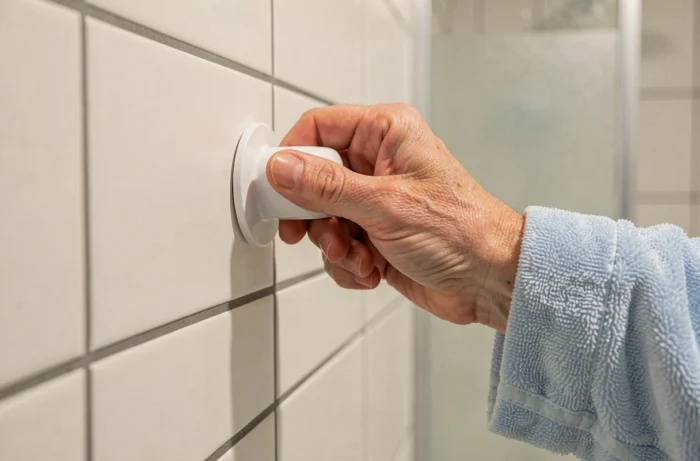
A suction grab bar is installed in a rental shower because drilling into the tiles isn’t an option. It seems like a sensible choice, takes two minutes to put up, and feels sturdy once pressed against the wall.
The problem arises a few weeks later, or at the exact moment you pull on it to steady yourself. Understanding what happens between the suction cup and the wall surface changes how you use this type of equipment—and, above all, what you expect from it.
Check before every use: the requirement no one anticipates
Most suction grab bar instructions call for checking the attachment before every use. This isn’t a maintenance tip; it’s a condition of use specified by the manufacturer.
In practice, this means manually testing the bar’s grip before getting into the shower. For someone living alone, this quickly becomes routine—and then gets forgotten. If a caregiver doesn’t visit every day, the check is left to the person who is most vulnerable.
This is what sets a suction grab bar apart from a screw-mounted one. A wall-mounted bar secured with screws and anchors doesn’t need to be checked every day. It stays firmly in place as long as the wall remains intact. A suction cup, on the other hand, can lose its grip without any visible warning: a slight lift, a film of soap, or a change in temperature may be enough.
If you’re looking for an opinion on suction grab bars, this daily check is the first factor to assess honestly: can you do it every single time, without exception?
Suction grab bars in rental homes: what they can and can’t do
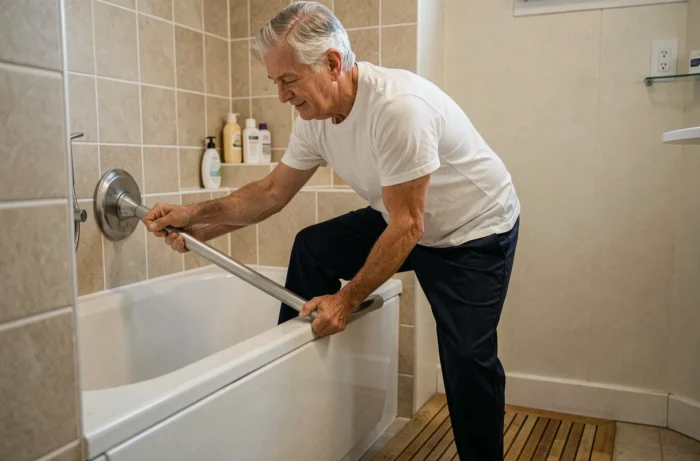
Suction grab bars solve a real problem in rental homes: making the bathroom safer without drilling into the wall. You put one up, remove it when you move out, and the landlord has nothing to object to. For temporary use—during recovery after surgery or while staying with a relative, for example—this flexibility is a real advantage.
Misunderstandings arise when it comes to what the bar is meant to do. The instructions for many models explicitly limit their use to helping with balance. You can lean on one lightly to steady yourself, but you shouldn’t pull yourself up with it or hang your weight from it if you slip.
What a suction cup can support
- Light, gradual pressure to steady yourself when getting into or out of the shower
- A tactile reference point to help you regain your balance if it is briefly disturbed
- Temporary support on a perfectly smooth surface
What a suction cup can’t reliably support
- A sudden pull perpendicular to the wall, such as an instinctive attempt to catch yourself after slipping
- The effort of pushing yourself up from a seated position
- Prolonged use without checks on a surface exposed to moisture and soap residue
The most tangible danger isn’t that the bar won’t hold at all. It’s that it holds well enough, for long enough, that you trust it more than you should. If the bar gives way as you try to catch yourself, it can make the fall worse: you fall with the bar in your hand, without having reached for another support.
Wall surface and attachment: the factors that make all the difference
“Smooth tile” is often described as a sufficient condition. The reality is more nuanced.
Tile may feel smooth to the touch but still have a microscopic texture that prevents the suction cup from forming a complete vacuum. The grout lines between tiles are a common point of failure: if a suction cup overlaps a grout line, the seal breaks and the grip weakens.
Tile size matters too. With small mosaic tiles, it may be physically impossible to position the suction cups without at least one resting on a grout line. Large-format tiles offer much more room to maneuver.
Compatible and incompatible surfaces
Glass surfaces, tempered glass shower screens, and large-format glazed tiles provide the best grip. By contrast, plaster, painted walls, porous polished concrete, wood, and textured tiles such as natural stone don’t provide a reliable surface for attachment.
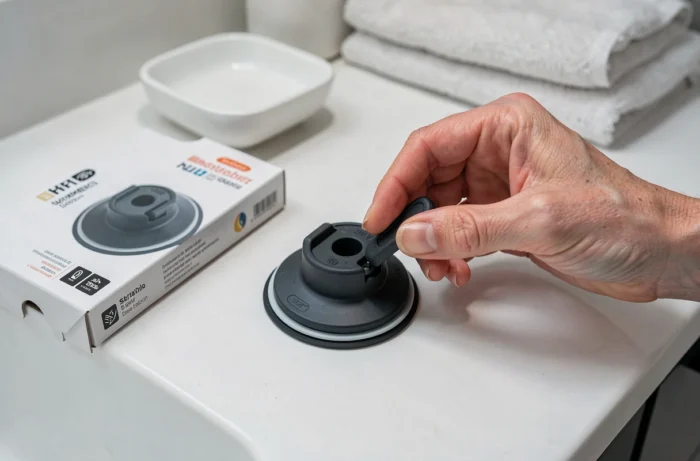
Some manufacturers include a colored indicator that turns red when the attachment weakens. It indicates the level of vacuum based on the manufacturer’s specifications, but it doesn’t make the bar equivalent to a wall anchor. The indicator warns of a problem; it doesn’t guarantee that there’s no risk.
Suction grab bar or screw-mounted bar: which should you choose?
The choice isn’t simply a matter of ranking one by quality. These are two different devices for different situations.
For a short-term rental, when someone has generally good balance and just wants a little extra support in the shower, a suction grab bar can do the job. Place it on clean, glazed tile, check it regularly, and remember that it won’t catch you if you fall.
In your own home, if balance problems are ongoing or getting worse, or if you’ll use the bar to get up from the toilet or step over a bathtub edge, a screw-mounted bar is the only serious option. A few holes drilled into a load-bearing wall are easy to fill, and installation costs remain modest.
For renters who need a secure wall-mounted bar, the solution often involves getting written permission from the landlord. Financial assistance may be available to adapt the home, and some landlords agree to the work if the tenant commits to restoring the property at the end of the lease.
A suction grab bar isn’t a bad product. Its range of uses is simply narrower than its appearance suggests. Use it for light, temporary support on a surface you’ve checked. For anything else, a wall-mounted bar secured with screws remains the most reliable option.