Burning sage, placing coarse salt in the corners, lighting a palo santo stick: the techniques to eliminate negative energies from a home circulate massively online. They draw from various traditions, from South American shamanism to Chinese feng shui. Their popularity shows no signs of waning, but one angle is rarely addressed: these purification rituals can themselves degrade indoor air quality.
Fumigation and Indoor Air Quality: A Little-Documented Tension
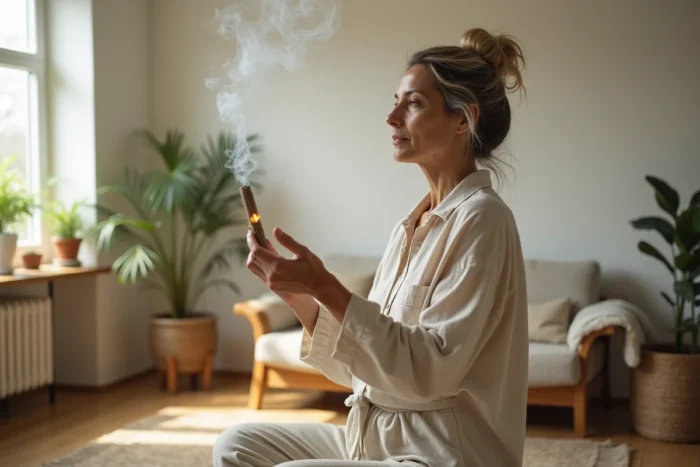
The majority of guides recommend burning white sage, palo santo, or incense to chase away negative energies from a space. The gesture seems simple and natural. However, the combustion of these materials releases benzene, formaldehyde, and fine particles into the room’s air.
In France and Europe, indoor air quality has become a priority health issue. Current recommendations urge limiting exposure to volatile organic compounds (VOCs) emitted by scented candles and incense sticks. Purifying fumigation and indoor pollution coexist in the same gesture, something most articles on energy cleansing fail to mention.
Knowing how to remove negative energies from a home therefore also involves measuring the side effects of the chosen methods. A purification ritual performed with closed windows, in a poorly ventilated room, can worsen the respiratory situation of the occupants rather than improve it.
The minimal reflex is to open the windows wide during and after any fumigation, regardless of the substance being burned. This practical detail transforms a potentially irritating ritual into a more reasonable gesture.
European Regulation on Incense and Purifying Candles
The market for incense and candles used in energy purification rituals is not exempt from European regulatory frameworks. The CLP regulation (Classification, Labelling and Packaging) requires manufacturers to indicate the presence of allergenic or toxic substances on the labels of their scented products.
The REACH regulation also restricts certain solvents and volatile organic compounds in ambient products. The market is shifting towards low-VOC formulations and incense without active charcoal, which emit fewer fine particles.
When purchasing white sage, palo santo, or benzoin for energy cleansing, checking the labeling remains a useful reflex. A product without composition mention or manufacturing traceability warrants caution, especially if it is imported outside of a controlled circuit.
What the Label Should Indicate
- The list of allergenic substances present above the regulatory threshold, in accordance with the CLP regulation
- The country of origin and the name of the manufacturer or importer responsible for marketing in Europe
- The possible mention of activated charcoal or synthetic binders in the composition of the incense
The absence of this information does not mean the product is dangerous, but field reports vary on this point: some artisanal incenses imported without control show VOC levels significantly higher than European references.
Coarse Salt, Sage, Palo Santo: What Each Method Involves
The three most cited methods for purifying a home, coarse salt, white sage, and palo santo, do not operate on the same level. Salt emits nothing into the air. Sage and palo santo rely on combustion. This simple criterion separates two families of practices with very different constraints.
Coarse Salt: No Emission, Regular Maintenance
Placing bowls of coarse salt in the corners of a room remains the most neutral method from an air quality perspective. No smoke, no particles. Tradition recommends replacing the salt weekly and disposing of it without reuse.
Its effectiveness relies on belief and personal ritual. The gesture has the advantage of presenting no identified health risks, which clearly distinguishes it from combustion methods.
White Sage and Palo Santo: Combustion and Precautions
White sage (Salvia apiana) primarily comes from the southwestern United States and Mexico. Palo santo (Bursera graveolens) grows in South America. These two sacred woods burn slowly and produce thick smoke, laden with particles.
To limit exposure:
- Open the windows before lighting the stick or bundle, not after
- Avoid fumigation in a room where young children or people with asthma are sleeping
- Prefer short sessions, a few minutes per room, rather than prolonged burning
- Check the product’s origin and composition on the label
Energy Purification Without Combustion: Often Ignored Alternatives
Several approaches to energy cleansing do not involve smoke. They remain minority results in search outcomes but better address concerns related to indoor air quality.
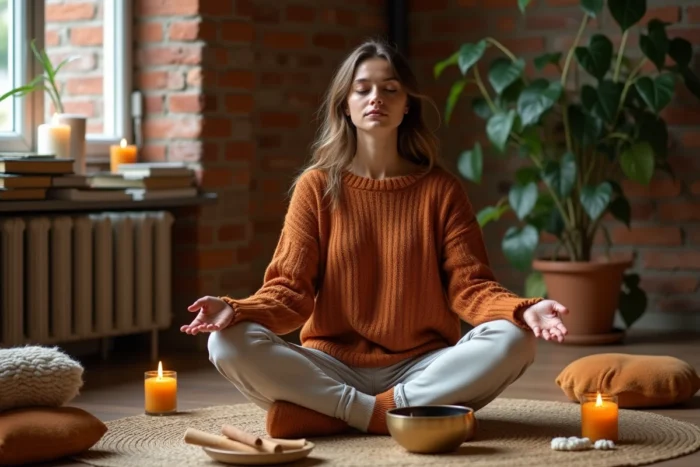
The Tibetan singing bowl produces sound vibrations without any chemical emissions. Tibetan tradition attributes to it the ability to “break” stagnant energies through resonance. The practice involves making the bowl sing in each room while moving slowly.
Moving furniture is another often underestimated method. Changing the layout of a room alters air circulation, natural light, and the perception of space. Feng shui formalizes this approach by linking furniture placement and energy flow.
Ventilating widely and regularly remains the simplest gesture to renew the atmosphere of an interior. Daily ventilation reduces pollutant concentration and alters the sensory perception of a place, which some traditions directly associate with space purification.
Purifying one’s home of negative energies is a personal endeavor whose perceived benefits vary from person to person. The choice of method benefits from incorporating a criterion rarely mentioned in guides: the real impact on the air you breathe. A purification ritual that degrades indoor air quality deserves, at the very least, to be practiced with windows open.