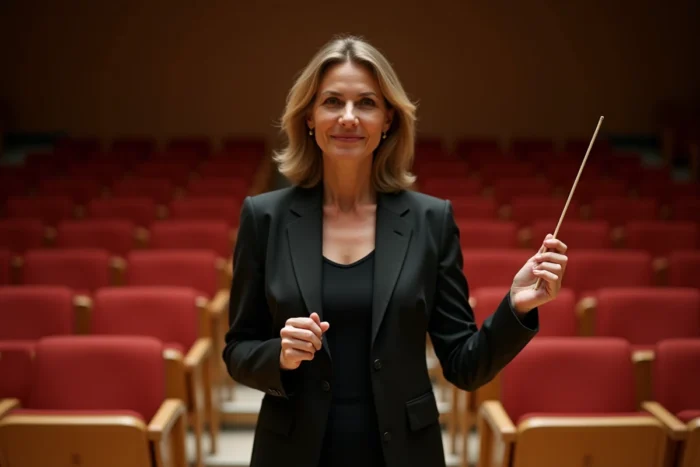
Zahia Ziouani was born in Paris on June 27, 1978. Twin sister of cellist Fettouma Ziouani, she founded the Orchestre Divertimento in 1998 and has since built one of the most visible conducting careers in France. Despite this growing media exposure, her married life remains a documentary blind spot that online searches do not fill.
Zahia Ziouani’s Married Life: A Topic Absent from Available Sources
Reference biographical databases and interviews published by cultural institutions mention no identified spouse or marriage. The Wikipedia page dedicated to the conductor details her birth, training, awards, and discography, without any section devoted to her romantic life.
This absence is not an editorial oversight. Cultural institutional profiles in France document an artist’s private life only when it has a direct link to their work or professional journey. For Zahia Ziouani, the public narrative is built exclusively around music, the orchestra, and social engagement.
Several recent articles do mention Zahia Ziouani and her husband as a subject of legitimate curiosity. However, none of these publications cite a primary source, direct statement, or public document confirming the identity of a spouse. The topic circulates in search results without ever finding a verifiable answer.

Conductor and Public Notoriety: Why the Question of the Husband Recurs in Searches
The query about Zahia Ziouani’s spouse fits into a classic pattern of digital curiosity. When a personality gains visibility, search engines mechanically record queries related to their private life. This phenomenon amplifies when the person concerned does not speak on the subject.
The release of the film Divertimento accelerated this dynamic. The cinematic adaptation of her journey, still relayed in 2024 by publications on social media and cultural event pages, propelled her name beyond the usual audience for classical music. Cinema creates a familiarity with the character that drives part of the audience to seek biographical details absent from the official narrative.
This gap between growing notoriety and silence about intimate life produces a feedback loop: the longer the question remains unanswered with documentation, the more it rises in search suggestions. Content attempting to address it multiplies, but none rely on a direct source.
Comparison with Other Figures in Classical Music
Marital discretion is not unique to Zahia Ziouani. In the field of conducting in France, private life is rarely exposed, except when the spouse is also a musician or public figure. This dynamic differs significantly from cinema or popular music, where romantic relationships are an integral part of the media narrative.
For a female conductor, the subject takes on an additional dimension. Available interviews show that Zahia Ziouani is questioned about her legitimacy in a historically male-dominated field, her relationship with working-class neighborhoods, and musical transmission. The question of marriage does not appear in any published institutional interview.
Orchestre Divertimento and Recent Career: The Facts That Structure Her Public Identity
The Orchestre Divertimento, founded when Zahia Ziouani was twenty years old, remains the central pillar of her public biography. The ensemble distinguishes itself by a focus on the democratization of classical music, with concerts in unusual venues and regular work with audiences far from traditional concert halls.
The available data for the 2025-2026 period confirms an increased presence in prestigious cultural events:
- Appearances related to festivals and solidarity concerts, such as the one documented in Bezons
- Collaborations with cultural institutions and brands, expanding its audience beyond the symphonic repertoire
- Regular presence on social media of partner organizations, with a tone centered on the artistic project
This trajectory shows that Zahia Ziouani’s notoriety rests on a triptych: musical direction, territorial engagement, and cinematic visibility related to the film Divertimento. None of these three axes mobilizes the private sphere.
The Film Divertimento as a Catalyst for Visibility
The feature film played a catalytic role that few documentaries or television portraits could achieve. By telling the story of two sisters from the Paris suburbs who create a symphony orchestra, the film reached an audience well beyond classical music enthusiasts.
This cinematic exposure also changed the nature of online searches concerning her. Before the film, queries focused on her concerts or her orchestra. Since then, they include more personal biographical inquiries, including one about her husband.

Boundary Between Private Life and Media Narrative: The Limits of an Online Investigation
The case of Zahia Ziouani illustrates a tension inherent to the digital age. On one side, an audience that considers it natural to access personal information about a public figure. On the other, a personality who constructs her communication exclusively around her work.
The available data does not allow for the confirmation of a husband’s existence. This formulation is not an admission of ignorance, but a methodological observation. In the absence of a public statement, mention in accessible records, or confirmation in a sourced interview, any assertion on the subject would be speculative.
Several websites produce articles optimized to capture this search query. Their content, once examined, cites no primary source. This mechanism of publication without verification raises a broader editorial question about how the web treats the private lives of cultural figures.
Zahia Ziouani continues to conduct, program concerts, and carry an artistic project that transcends classical music in the strict sense. Her public identity is built through artistic gesture, not intimate narrative. For those seeking to understand her journey, the documented facts, from the creation of Divertimento in 1998 to her recent collaborations, constitute a much denser corpus than the mere question of her married life.