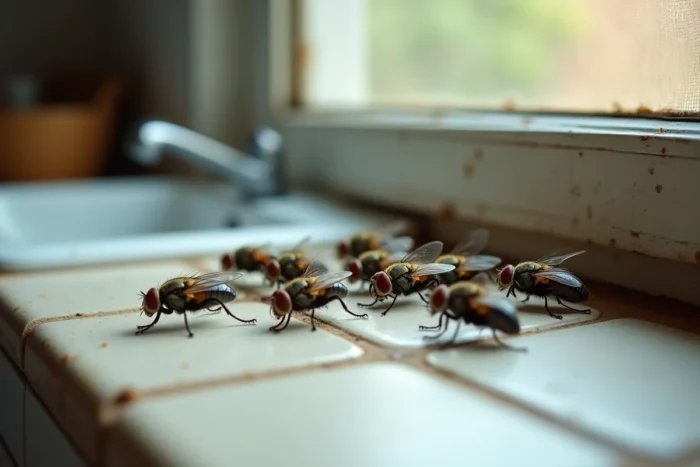
A forgotten trash can left for two days under the sink in the middle of summer, and within forty-eight hours, you find dozens of flies in the kitchen. The invasion of flies in the house never happens by chance: it signals a specific imbalance in the domestic environment, often related to waste management, the state of the plumbing, or the ambient heat. The consequences go beyond mere nuisance, as these insects carry pathogens that directly contaminate food.
Biofilm in the plumbing: the unsuspected source of flies
We first think of overripe fruit or a poorly closed trash can. But when the infestation persists despite careful cleaning, the problem often comes from deeper down. Kitchen and bathroom plumbing accumulates an organic biofilm made up of grease, food residues, and hair. This damp and warm deposit serves as a breeding ground for drain flies (Psychodidae), those small insects with rounded wings that can be found resting on the walls of the sink.
The reproduction cycle in this environment is rapid. The larvae feed directly on the biofilm, making the infestation self-sustaining as long as the plumbing is not cleaned. A simple drain cleaner is not always sufficient: mechanical brushing of the siphon and the internal walls of the pipe is necessary to break the cycle.
Understanding the meaning of a fly invasion in the house allows one to trace back to these structural causes rather than just treating the visible symptoms.

Heat waves and accelerated reproduction of house flies
Since the recent scorching summers in France, several municipalities have documented a sharp increase in fly invasions in homes. Prolonged heat significantly accelerates the reproduction cycle of the house fly (Musca domestica). The higher the temperature, the shorter the time from egg to adult, and the more the insects seek the relative coolness of our interiors.
Each female can lay several hundred eggs during her short life. When the season is favorable, a small neglected population can turn into an infestation in just a few days. The speed of the phenomenon is often underestimated: between laying and the emergence of new adult flies, it can sometimes be less than two weeks in warm conditions.
The trap of agricultural proximity
Living near a cattle or horse farm amplifies the problem. The organic matter produced by these operations massively attracts flies, which then migrate to nearby homes. In this case, the nuisance does not solely depend on the hygiene of the dwelling, and feedback on the effectiveness of purely domestic solutions varies.
Food contamination: concrete health risks
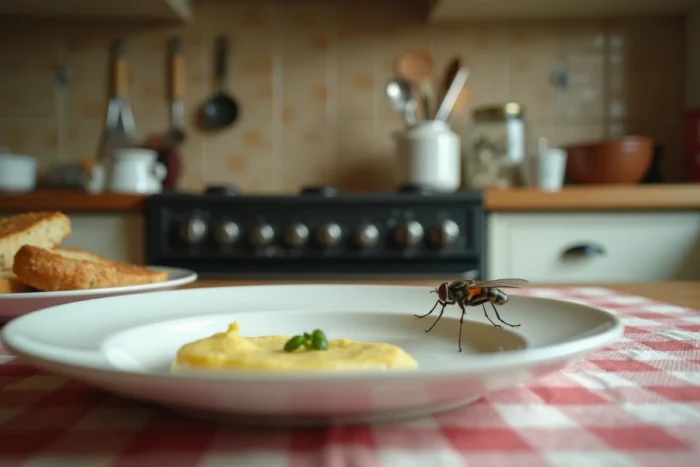
Flies do not bite (except for certain species like stable flies), but their feeding method poses a real problem. They regurgitate digestive juices onto food before sucking it up, depositing bacteria collected from their previous points of contact: trash cans, feces, decomposing matter.
Among the pathogens identified on house flies:
- Staphylococcus and Streptococcus, responsible for skin and ENT infections, carried on their legs and body covered with microscopic hairs
- Salmonella, a source of sometimes severe food poisoning, transmitted by direct contact with uncovered food
- Eggs of parasitic worms, deposited on food preparation surfaces when flies land after visiting animal feces
Systematically covering food and emptying trash cans daily significantly reduces the risk of contamination. This is not just a comfort tip; it’s a direct food hygiene measure.
Presence of flies and respiratory allergies
Less often discussed, but fly droppings and fragments of dead larvae mix with indoor dust. In sensitive or asthmatic individuals, this presence can exacerbate respiratory symptoms. Treating the infestation then becomes a health issue, not just a comfort one.
Breeding sites in the house: where to look to break the cycle
When aiming to eliminate a fly infestation sustainably, it is essential to locate breeding sites rather than killing adults one by one. Flies lay their eggs on damp organic matter. Here are the places to inspect as a priority:
- The bottom of trash cans, even when the bag seems intact: liquid residues accumulate under the bag and provide a perfect substrate for larvae
- The siphons of sinks and showers, where the biofilm continuously provides food and moisture
- Indoor compost bins that are poorly ventilated or too humid, which also attract fruit flies (Drosophila)
- Animal litter, stagnant water bowls, and forgotten food products in a cupboard
Eliminating the breeding site stops reproduction within a few days. Without this action, sticky traps and sprays will only temporarily slow down the proliferation.
Stagnant water around the house
Flower pot saucers, clogged gutters, and uncovered rainwater collectors create attraction zones for several species of flying pests. Flies find the necessary moisture for their larvae’s survival there. A tour of the garden or balcony to remove these water points significantly reduces the pressure of entry into the home.
The persistent presence of flies despite rigorous cleaning may also signal a hidden problem: a dead animal in a wall cavity, a water leak feeding mold, or a clogged ventilation duct. In these situations, calling in a pest control professional helps identify the source without risky disassembly.
A fly invasion is never just an aesthetic inconvenience. It reflects a flaw in the management of organic matter or in the sealing of the dwelling, exposing occupants to documented food contamination risks. Locating breeding sites, cleaning plumbing, and covering food: these three combined actions resolve the majority of situations before a heavier treatment becomes necessary.