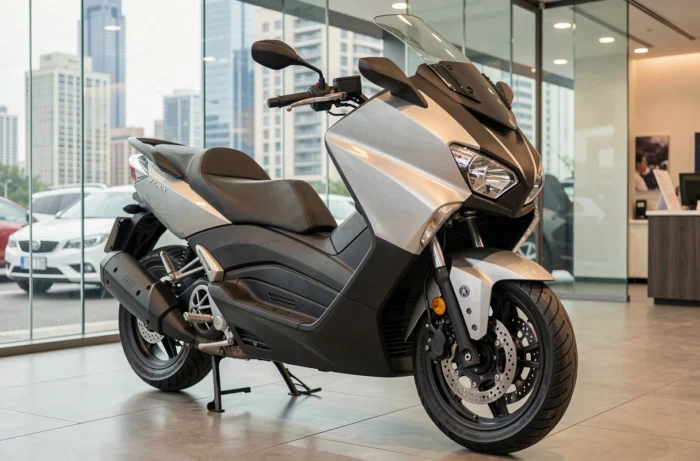
The Yamaha TMAX 750 has shown a steadily increasing price for several years. For 2026, the list prices communicated by various European markets confirm a repositioning of prices upwards. What structural factors explain this trajectory, and to what extent does the motorcycle market context amplify the phenomenon?
TMAX 2026 List Prices in Europe: Price Differences by Country
The prices of the TMAX vary by market, but the trend is uniform. A table allows us to visualize the structuring of the 2026 range as it emerges from available sources.
| Version | Price Spain (2026) | Price United Kingdom (Tech MAX) |
|---|---|---|
| Standard TMAX | €14,299 | – |
| 25th Anniversary TMAX | €14,599 | – |
| TMAX Tech MAX | €16,299 | £14,553 |
The gap between the standard version and the Tech MAX reaches €2,000 in the Spanish market. This three-tier structure (standard, special edition, premium) did not exist in this form a few years ago. It reflects a strategy of upward repositioning embraced by Yamaha.
Several motorcycle distribution analysts note that these increases remain modest in absolute terms. However, they cross psychological thresholds, particularly the €16,000 mark for the most equipped version.
To understand what justifies these tiers, one must look at the price of the new TMAX 750 in terms of onboard equipment and positioning against competitors.

Market Contraction and Rebound: The Effect on Scooter Prices
The price of a model is not determined solely by its production costs. The relationship between supply and demand plays a direct role in the pricing policy of manufacturers.
After five consecutive years of growth between 2020 and 2024, the European motorcycle and scooter market recorded a 7.8% drop in registrations in 2025. This downturn caused a stockpiling effect among some dealers, without leading to significant reductions in list prices.
In 2026, the situation reverses. Sales rebound with increases exceeding 10% in several European markets. In France, the first half shows a 6.4% increase for motorcycles and scooters over 125 cc.
Why a Demand Rebound Pushes Prices Up
When demand rebounds after a year of decline, manufacturers have less excess stock to clear. Dealer discounts decrease, and the list prices set at the beginning of the year hold better.
For a model like the TMAX, which dominates the maxi-scooter segment with over 340,000 units sold in Europe since 2001, demand remains structurally strong. The rebound in 2026 eliminates the only lever that allowed buyers to negotiate: the surplus stock.
Euro Standards and Compliance Costs for the TMAX
The European emissions regulations constitute a cost factor rarely detailed in price comparisons. Each transition to a new standard requires manufacturers to invest in research and development, followed by adaptation of production lines.
- The current TMAX’s 560 cc twin-cylinder engine meets the Euro 5+ standard, necessitating modifications to the injection system and catalyst compared to previous generations.
- The gradual introduction of Euro 6 requirements for L-category vehicles (motorcycles and scooters) involves new sensors, more precise electronic management, and more comprehensive onboard diagnostic systems.
- These additional components directly impact the unit cost, without the consumer always perceiving a gain in performance or comfort.
Regulatory compliance represents an unavoidable cost that Yamaha incorporates into its pricing over the years. This expense item will not decrease: the standards only continue to tighten.
25th Anniversary Edition and Yamaha’s Premium Strategy
The release of a limited 25th anniversary edition in 2026 is not a matter of calendar coincidence. It is part of a strategy to enhance the TMAX brand that elevates the entire range.
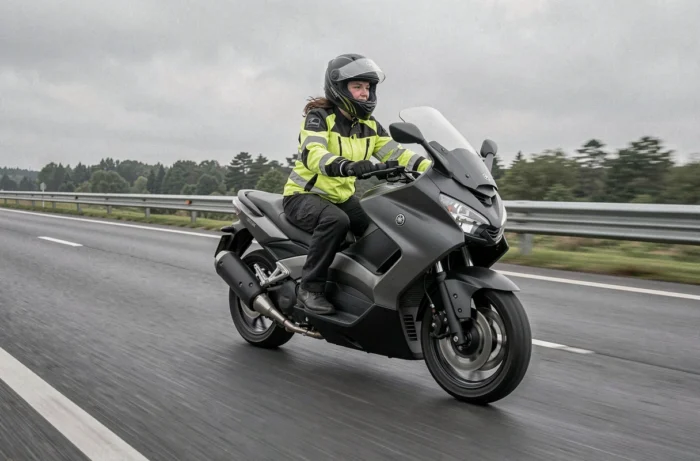
This special edition features a design inspired by the Black MAX from 2006, with a matte metallic gray finish and a red seat. Beyond aesthetics, it is priced at €300 above the standard TMAX in Spain, a modest difference that is enough to create a sense of rarity and psychologically anchor the base model’s price as “reasonable” by comparison.
The Range Effect on Price Perception
By offering three versions, including one priced over €16,000, Yamaha repositions the standard TMAX at €14,299 as a relative entry-level model. This mechanism, well-documented in marketing, pushes the average transaction prices upward without making the cheapest model seem excessive.
The Tech MAX version concentrates connected features, advanced riding modes, and premium finishes. It serves as a technological showcase. In comparison, the anniversary TMAX plays on emotion and rarity, available for only one year.
- Standard TMAX: “access” positioning, the lowest price but already increasing compared to previous generations.
- 25th Anniversary TMAX: limited series, collector’s effect, production restricted to 2026.
- TMAX Tech MAX: high-end technology, screen, connectivity, adjustable suspension.
This three-tier architecture did not exist in the early generations of the TMAX. It reflects the transformation of the maxi-scooter into a premium product, comparable in its pricing logic to certain mid-range motorcycles.
Thus, the price of the TMAX 2026 results from the convergence of three forces: a recovering European market that limits negotiation margins, increasing regulatory costs related to emission standards, and a range strategy that deliberately pushes prices upward. For a buyer, the accessible price window remains the standard model, but the crossing of the €15,000 threshold for the intermediate edition marks a new milestone in the history of the TMAX.