
Rolling tobacco purchased in Spain remains significantly cheaper than in France, and this price difference motivates thousands of trips to border towns each year. However, a common misconception circulates: prices would vary depending on the Spanish city where it is purchased. The reality is simpler, and understanding the pricing mechanism helps avoid unnecessary detours.
Rolling tobacco in Spain: prices set at the national level, not by city
Have you ever compared prices between La Jonquera, Madrid, and Seville hoping to find a discrepancy? There isn’t one. Prices for rolling tobacco are identical in all estancos across the Peninsula and the Balearic Islands. It is the Comisionado para el Mercado de Tabacos, attached to the Spanish Ministry of Finance (Hacienda), that publishes the official prices in the BOE (Boletín Oficial del Estado).
Specifically, each resolution sets a retail price by brand and format. A pack of Frérot Blond 30 g displayed in an estanco in Barcelona costs exactly the same as in Bilbao or Malaga. The latest resolution, dated July 31, 2026, updated the prices with an effective date of August 1, 2026.
The variations that some travelers believe to observe are explained by the assortments available from one tobacco shop to another, not by price differences. A busy border estanco often offers more brands than a small city center shop, creating an illusion of a more advantageous choice.
To check the prices of rolling tobacco in Spain by city in 2026, keep in mind that these rates reflect a national grid, not geographical discrepancies.
Price of rolling tobacco 30 g in Spain: concrete example since August 2026
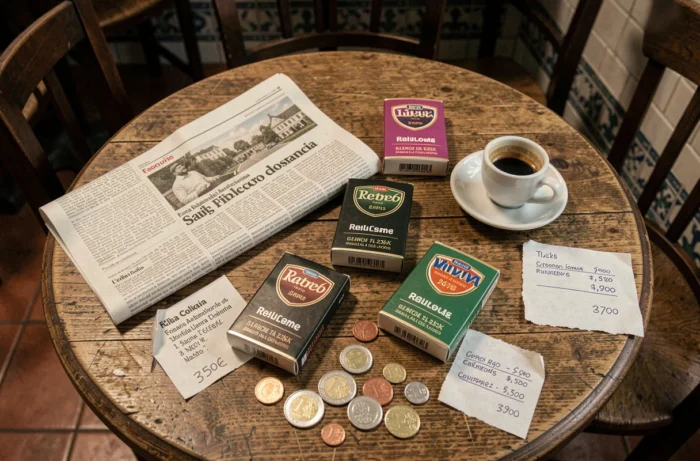
Rather than listing vague ranges, let’s take a specific case. According to the resolution of July 31, 2026, published in the BOE, the picadura de liar Frérot Blond 30 g is priced at 5.90 euros in the Peninsula and Balearic Islands. This price has been in effect since August 1, 2026, at all authorized points of sale.
This unique price contrasts with the French situation, where an equivalent product costs significantly more. The gap remains significant in 2026, even though rising Spanish taxes are gradually eating into the difference.
Why prices are also rising in Spain
The European Union encourages its member states to raise tobacco taxation through directives on excise duties. Spain is not exempt from this trend. Spanish tax increases are gradual but regular, and each new resolution from the BOE can change the prices of several brands simultaneously.
The August 2026 resolution affected around thirty brands. Some saw their prices adjusted upwards, while others remained stable. The mechanism is simple: the manufacturer proposes a new price, the Comisionado validates and publishes it.
Canaries, Ceuta, and Melilla: the only real geographical discrepancies
If a city comparison makes no sense on the Peninsula, territories with special taxation are the only real exception. The Canary Islands, Ceuta, and Melilla benefit from a distinct tax regime that results in tobacco prices significantly lower than those on the Spanish mainland.
In the Canaries, tobacco is not subject to the same excise duties as on the Peninsula. The result: a pack of rolling tobacco costs significantly less there. This difference attracts buyers, but it comes with specific customs rules, including for trips between the Canaries and the Peninsula.
- Peninsula and Balearic Islands: unique national price, set by the BOE, identical in all authorized estancos
- Canaries: reduced taxation due to the IGIC regime (no standard Spanish VAT), lower tobacco prices
- Ceuta and Melilla: free trade zones with a different taxation system, but the range of brands is more limited

Comparison of tobacco Spain-France: where the real savings lie in 2026
The interest in buying rolling tobacco in Spain is not measured between Madrid and Valencia (same price), but between Spain and France. At 5.90 euros for a 30 g pack of Frérot Blond, the gap with a similar product sold in a French tobacco shop remains marked.
What really matters for the budget
Before planning a trip, a few parameters deserve to be clearly stated:
- The cost of travel (fuel, tolls, time) should be compared to the savings made on tobacco
- The French customs allows a maximum quantity set by regulations, which caps the possible savings per trip
- Border estancos (La Jonquera, Le Perthus, Irun) offer the same prices as everywhere in the Peninsula, but with a wider choice of brands
- Andorra is an alternative with even lower taxation, but the quantities allowed for return to France are different
The classic trap is to multiply short trips thinking to save more, without factoring in the actual cost of travel. For an occasional smoker, the net savings may prove marginal once the fuel cost is accounted for.
Border estancos: same price, better assortment
La Jonquera, Le Perthus, or Irun do not offer preferential rates. Their advantage lies in the diversity of available brands and opening hours suited to French customers. The choice of purchase point depends on proximity and assortment, not price.
A city center estanco in Madrid sells the same Frérot Blond 30 g at the same price as an estanco located 200 meters from the French border. The difference lies in the availability of formats and brands favored by French buyers, which border shops prioritize stocking.
The real comparison in 2026 does not pit Spanish cities against each other, but rather compares the Spanish Peninsula to its territories with reduced taxation on one side, and France on the other. Keeping this framework in mind avoids false calculations and financially pointless detours.