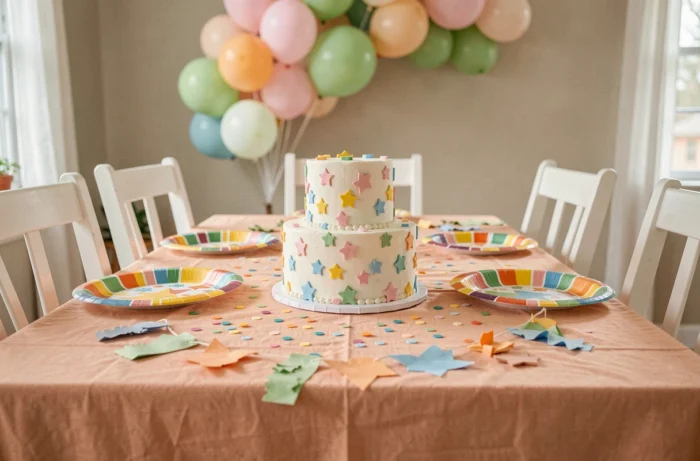
Organizing a children’s party means managing the energy of a group, the expectations of the guest of honor, and the practical constraints of the venue simultaneously. The difference between a chaotic afternoon and a good memory rarely lies in the budget: it comes down to a few choices made in advance, even before sending out the invitations.
Toy safety and allergies: the real invisible work of a children’s party
Most organizational guides talk about themes and decorations. Before getting to that, two subjects deserve special attention because they condition everything else.
Are you planning small gifts for the guests, costume accessories, or construction games to share? The CE marking alone does not guarantee that a toy is suitable for the age group present. The DGCCRF recommends checking the age indicated on the packaging and the warnings regarding small parts.
For battery-operated toys, check the sturdiness of the compartment. With children aged three to six, an accessory intended for ages eight and up becomes a concrete risk.
On the food side, managing allergies as a protocol changes the game. Collect known allergies, prohibited foods, and prescribed treatments from each parent in advance. On the day of the party, keep the packaging of the served products for quick verification in case of doubt.
To find inspiration for activities and decorations while keeping these precautions in mind, platforms like jolis-momes.fr offer resources tailored for children’s parties.
Screen-free activities to channel the group’s energy
Have you noticed that a movie started to “calm” a group of hyperactive children rarely works for more than ten minutes? The children lose interest, fidget, and the party loses its rhythm. A government guide published in September 2026 reminds us that screens should not serve as a default activity for three to six-year-olds. It’s better to plan independent or musical activities.
Three formats of activities work particularly well for mixed-age groups:
- The adaptable treasure hunt: prepare visual clues (drawings, photos) for the younger ones and written riddles for the older ones. Both levels coexist on the same course, with each pair progressing at their own pace.
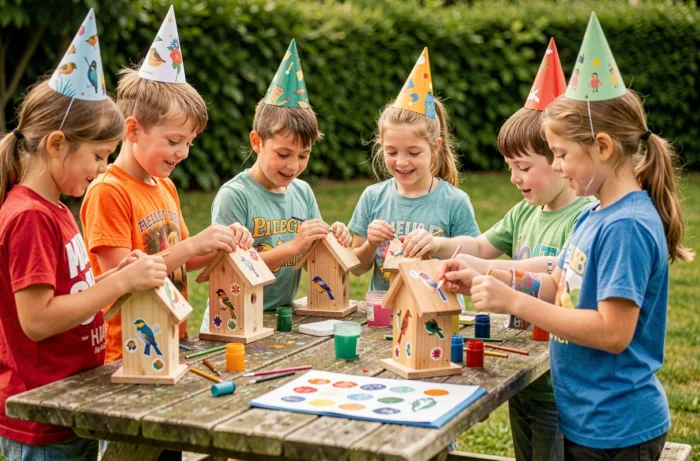
- The open-access creative workshop: set up a table with collage materials, markers, and a common support (large sheet, cardboard). Children can come and go freely between games, creating a natural calm zone.
- The musical relay: a variation of musical chairs where no one is eliminated. When the music stops, each child must join a hoop. One hoop is removed each round, but the children share the remaining ones. The game becomes cooperative instead of competitive.
Planning a calm welcome activity as soon as the first guests arrive avoids the dead time where excitement builds without structure. A collective coloring activity or a tabletop seek-and-find game serves this purpose perfectly.
Decoration and party theme: doing a lot with little
The theme of a children’s party does not require a movie set decoration. Two or three coherent visual elements are enough to create an atmosphere that children immediately identify. A color code applied to balloons, napkins, and the tablecloth already provides a strong unity.
Involving the child in choosing the theme turns preparation into a standalone activity. Offer them three realistic options rather than an open choice. “Pirates, space, or forest animals?” works better than “What theme do you want?” because the framework reduces indecision.
For indoor decoration, focus your efforts on two areas: the entrance (first visual contact) and the snack table (the most photographed moment). The rest of the room can remain understated. Children do not notice the garlands on the ceiling when they are chasing a balloon.
The snack as the central moment
The birthday cake remains the highlight for most children. Everything else at the snack can be simple: individual portions, easy to eat standing or sitting, without cutlery if possible. Think of mini sandwiches, fruit skewers, and small cookies.
Serving the snack midway rather than at the end allows you to split the afternoon into two distinct parts. The group gathers around the table, blows out the candles, and then leaves with renewed energy for the last activities.
Time organization: pacing the party without making it rigid
A successful children’s party follows a rhythm, not a minute-by-minute schedule. Plan blocks of twenty to thirty minutes per activity, with smooth transitions. The classic pitfall: chaining too many games without a break, which exhausts the group and the adults.
Three well-prepared activities are better than six improvised ones. Keep a backup activity (a simple game like “Simon Says” or a light face painting workshop) ready to fill a gap or replace a game that isn’t working.
Managing the guests also affects the rhythm. For children under six, a group of six to eight children is manageable with two adults. Beyond that, supervision dilutes and conflicts multiply. Plan an accessible rest area, with cushions and a few books, for children who need to take a break without leaving the party.
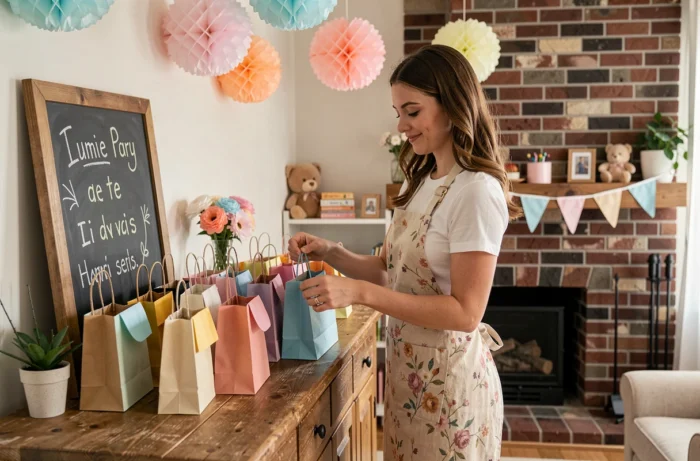
Last often overlooked point: communicating the end time to parents on the invitation avoids staggered departures that disrupt the last half hour. A clear ending, with the distribution of small souvenir gifts, gives a clear signal to everyone.