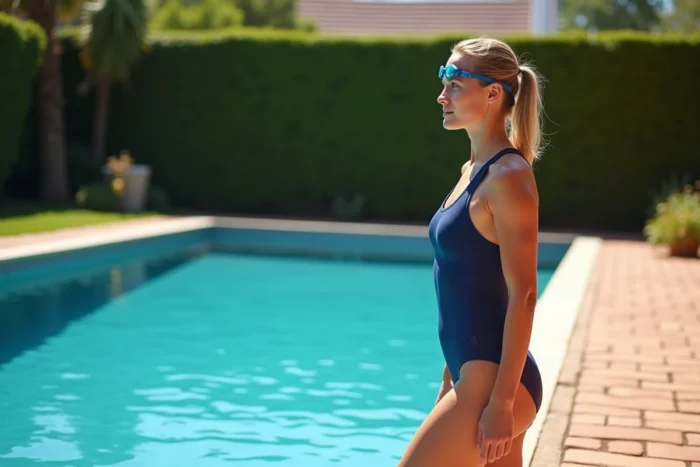
Swimming lengths at home requires a pool whose length, width, and depth are designed to allow for a regular swimming stroke. The size of the pool to consider depends less on a standard format than on the minimum distance needed to perform movements without having to turn around every few seconds.
Swimming Depth: The Parameter That Length Cannot Replace
Most guides on pool size focus on the length of the pool. Depth receives less attention, even though it directly affects the quality of each stroke.
To swim comfortably in freestyle or breaststroke, a depth of between 1.20 and 1.50 m is sufficient. This range allows the body to remain horizontal without hands or feet hitting the bottom during strokes. Below 1.20 m, swimming becomes constrained: the swimmer adopts a semi-vertical position that strains the lower back and reduces glide.
A flat bottom along the entire length of the pool is preferable to a sloped bottom for competitive swimming. The slope, designed to provide gradual access for children, creates a shallow area where swimming becomes impossible. If the pool also needs to accommodate the family, it is better to plan for a short slope concentrated over the first two meters, followed by a flat bottom for the rest of the length.
Additional dimensions and advice on this topic are detailed on the By Caroline and CO website with a practical angle useful for refining your project.
Minimum Length for Swimming Lengths Without Frustration
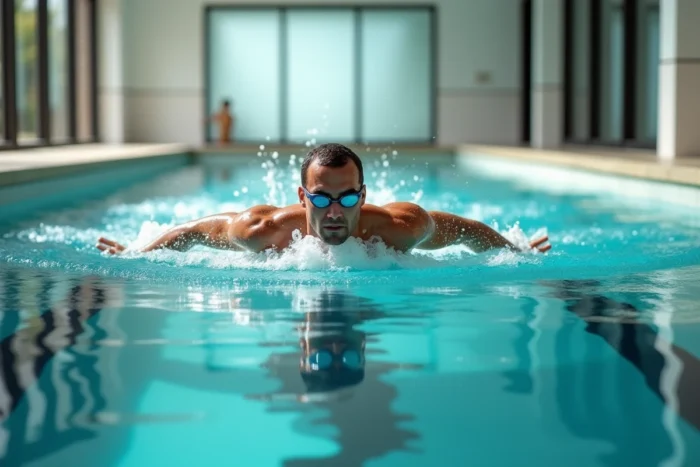
A classic family pool of 8 meters allows for bathing but not really for swimming. After a few strokes, the wall is reached. The time spent turning quickly exceeds the actual swimming time, and the exercise loses its cardiovascular interest.
The comfortable minimum length is around 10 to 12 meters. From 10 m, each length provides enough distance to reach a cruising pace before the turn. The ratio of swimming time to turning time becomes acceptable.
For more athletic practice (regular training, fast swimming), pools of 15 to 25 m are recommended. A 15 m swimming lane already offers comfort close to that of a municipal pool on a smaller scale. Beyond 20 m, the comfort gained per additional meter decreases, but the footprint and cost increase significantly.
The 6×3 Format: A Realistic Compromise for Small Gardens
Field feedback shows that a pool of 6 m by 3 m already allows for straight swimming, provided one accepts short lengths. This format does not replace a swimming lane, but it offers enough space for slow swimming and aquatic exercises.
A 6 m pool is suitable for fitness, not for training. This distinction matters when setting expectations.
Width of the Swimming Pool: Between Comfort and Footprint
The ideal width depends on the number of simultaneous swimmers and the type of use. Two benchmarks emerge from common practices:
- To swim alone in a straight line, a swimming lane of 2 to 3 m wide is sufficient. This configuration optimizes ground space and reduces the volume of water to treat and heat.
- To alternate swimming and family play, a width of 3 to 4 m allows two people to cross without inconvenience. The pool remains usable as a leisure pool on weekends.
- Beyond 4 m in width, the pool moves away from the logic of a swimming lane to become a versatile pool. The surface area of water increases, along with the budget for filtration, maintenance, and heating.
The choice of width is a trade-off between square meters of water and square meters of garden. Each additional meter in width consumes more usable space than the same meter added in length.
Clearance Around the Pool: The Surface That Plans Often Overlook
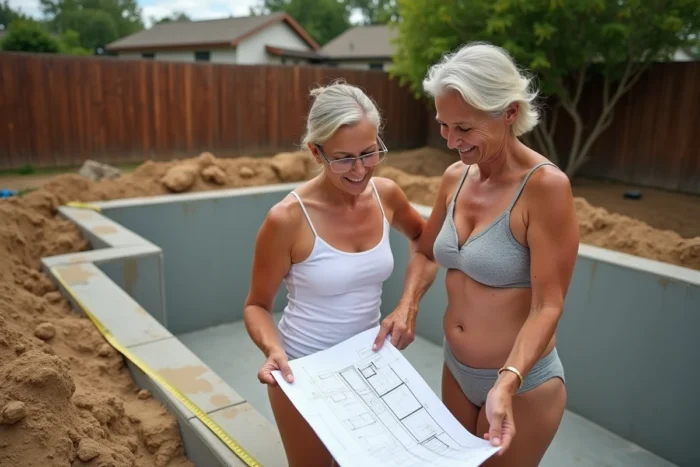
A swimming lane of 12 m by 3 m occupies 36 m² of water surface. But the actual footprint is much larger. Several sources recommend allowing 1 to 1.5 m of free clearance all around the pool. This margin is used for circulation, placing a deckchair, accessing the technical room, and respecting regulatory distances from property boundaries.
In practice, a 12 x 3 m pool with 1.5 m of peripheral beach occupies about 15 m by 6 m, or 90 m² of land. On a plot of 300 m², this represents nearly a third of the total surface area. This footprint calculation should be done before setting the length of the pool, not after.
Counter-Current Swimming: An Alternative to Length
When the terrain does not allow for a pool of 10 m or more, counter-current swimming offers a functional solution. A turbine system generates a continuous flow of water against which the swimmer moves in place, never reaching the wall.
This device transforms a pool of 5 or 6 m into a space for nearly unlimited swimming. The installation cost varies depending on the power of the turbine and the type of integration (built-in or surface-mounted). The flow must be steady and wide enough to cover shoulder width; otherwise, the swimmer drifts laterally.
- Built-in systems offer a more uniform current but need to be planned during construction.
- Surface-mounted systems can be added to an existing pool, usually with a more limited flow rate.
- The pump’s power must be adapted to the swimmer’s size: a flow that is too weak cannot withstand fast swimming.
Counter-current swimming does not replicate the sensation of a true length. The turn disappears, as does the wall push. For complete training, nothing replaces a pool of at least 10 to 12 m long. Counter-current remains a relevant complement, not a total substitute.
The proper sizing of a pool for swimming depends on a balance between the length of the pool, the usable depth, and the available space around it. First determining the actual ground footprint, including clearances, prevents discovering too late that the garden does not accommodate the project.