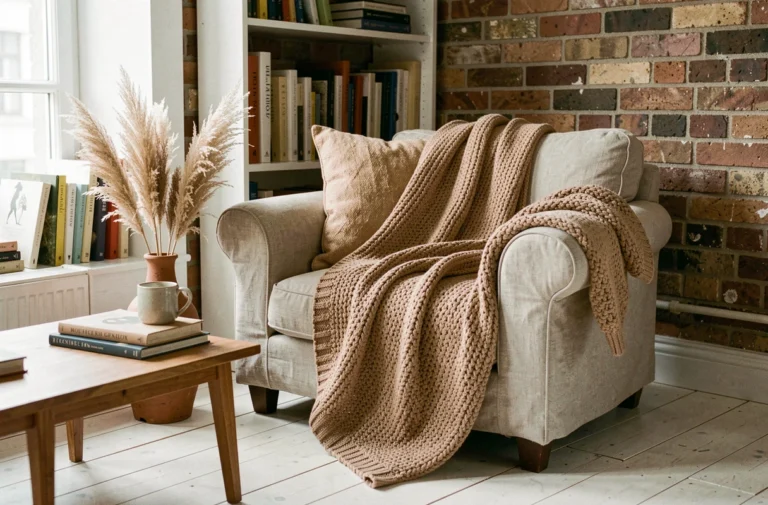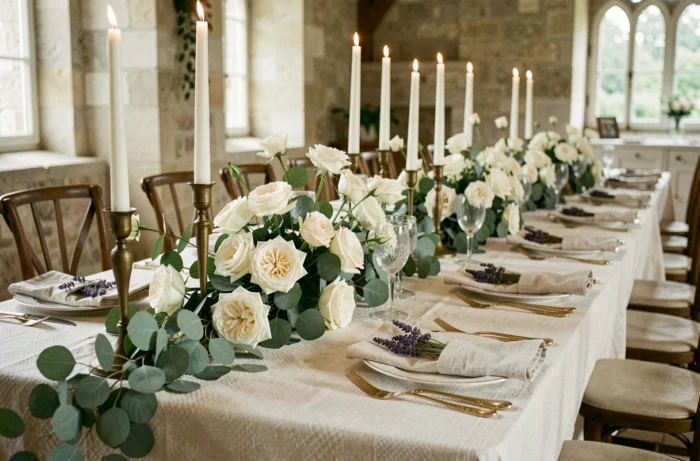
Wedding decoration is no longer just about choosing a theme and applying it to each table. The current trend leans towards a comprehensive scenographic approach, where every space traversed by guests (parking, aisle, ceremony room, cocktail area, dance floor) contributes to a visual narrative. This pathway logic changes how the budget and decorative efforts are allocated.
Visual journey of the wedding: from the entrance to the dance floor without over-decorating
Most couples concentrate their budget on the table and reception hall. Transition areas (venue entrance, path to the ceremony, passage between cocktail and dinner) often remain bare or decorated in a trivial manner. This is a costly blind spot, as these spaces are the first ones guests photograph.
Creating a coherent visual journey requires prioritizing contact points. The entrance sets the tone: a floral arch or a vintage welcome sign is enough to anchor the ambiance. The corridor or aisle leading to the ceremony can use the same colors with lighter elements (candles on the ground, draped fabric on chairs). The reception hall extends this palette without overwhelming it.
A common mistake is to multiply decorative elements on every available surface. A readable journey relies on the repetition of two or three materials and colors, not on accumulation. A scenographed buffet with vintage tableware, draped textiles, and a few dried flowers creates more impact than an entire wall of balloons placed in a corner that no one looks at after the first hour.
Specialized wedding scenography providers offer this work of overall coherence, as can be seen on https://www.ddaydeco.fr/ which brings together various event decoration services.

Vintage and second-hand wedding decoration: beyond the trend
The use of second-hand objects in wedding decoration goes beyond simple ecological arguments. Antique silverware, mismatched frames, and linen tablecloths found at flea markets bring a texture and patina that no rental catalog can replicate. Vintage items tell a visual story that new items cannot imitate.
This approach poses concrete logistical constraints. Thrifting takes time, sometimes several months, and requires storage for the pieces. There is a risk of ending up with items that do not work together. To limit this problem, a simple method is to first establish a palette of a maximum of three colors and only keep the pieces that fit within it.
What is easy to thrift and what is not
- Containers (vases, carafes, candle holders) are easily found at flea markets and recycling centers, often at a lower cost than rentals
- Textiles (tablecloths, table runners, cloth napkins) require more sorting to achieve uniform tones, but their appearance on the table is significantly superior to rental polyester
- Accent furniture (consoles, side tables, mirrors) is the most complicated to transport and integrate, but they transform a plain buffet into a true decorative installation
Field reports vary on the cost-effectiveness of fully thrifted decor. Some couples spend as much on time and gas as they would have on rentals. The hybrid formula (rented structure, thrifted details) is likely the most realistic for most budgets.
Table scenography: what guests really notice
The reception table captures the majority of guests’ attention for several hours. The centerpiece is the most photographed element of the entire decoration. Available data does not allow for precise quantification of this impact, but every wedding planner confirms that the table makes or breaks the overall impression.
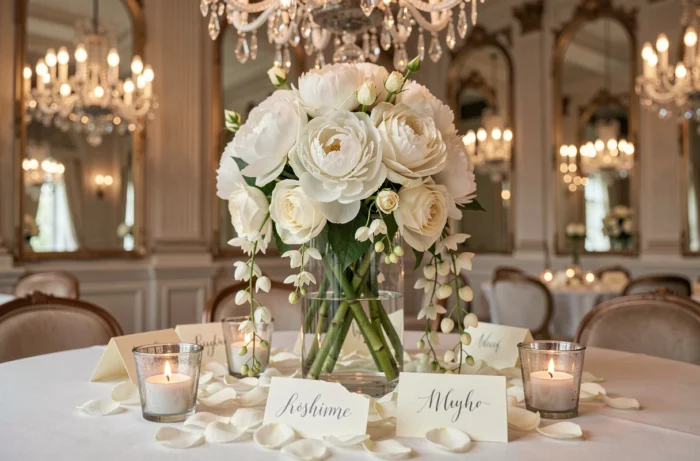
There are two opposing schools of thought. The first focuses on tall centerpieces (candelabras, high floral arrangements) that free up sightlines and facilitate conversation. The second prefers low, lush arrangements that create a more intimate atmosphere, visually bringing guests closer together. The choice depends as much on the ceiling height as on the number of guests per table.
One often underestimated element: the color of the tablecloth radically alters the perception of everything placed on it. A raw linen or cream cotton tablecloth enhances the flowers and tableware effortlessly. In contrast, a shiny white polyester tablecloth flattens details and gives a standardized look, regardless of the quality of the items placed on it.
Table lighting ambiance: candles, garlands, or nothing
Light remains the most underutilized lever in table decoration. Real flame candles in glass holders create a warm reflection that changes the atmosphere as daylight fades. Micro-filament LED garlands, slipped into a low floral arrangement, work well in low-ceiling venues where candles emit too much heat.
Colored spotlights directed at the tables rarely produce the desired effect. Colored light alters the perception of dishes and faces, which is more distracting than impressive.
Wedding flowers: fresh, dried, or a thoughtful mix
The choice between fresh and dried flowers is not just a budget issue. Dried flowers last several weeks before the big day, allowing for advance preparation of arrangements and reducing logistical stress. Dried flowers offer a flexibility in preparation that fresh ones do not allow.
Fresh flowers, on the other hand, provide volume, fragrance, and vibrancy that dried flowers cannot replicate. A bouquet of fresh peonies on the head table has no equivalent in dried form. The most interesting solution combines both: dried arrangements for peripheral areas (entrance, bar, photobooth) and fresh flowers concentrated on the ceremony and the table.
- Dried grasses (pampas, broom) work well in large quantities to dress arches or photo corners
- Dried roses and hydrangeas maintain their shape but lose vibrancy, best reserved for mixed arrangements
- Seasonal fresh flowers are cheaper and last longer than imported varieties, reducing the risk of wilting before the evening
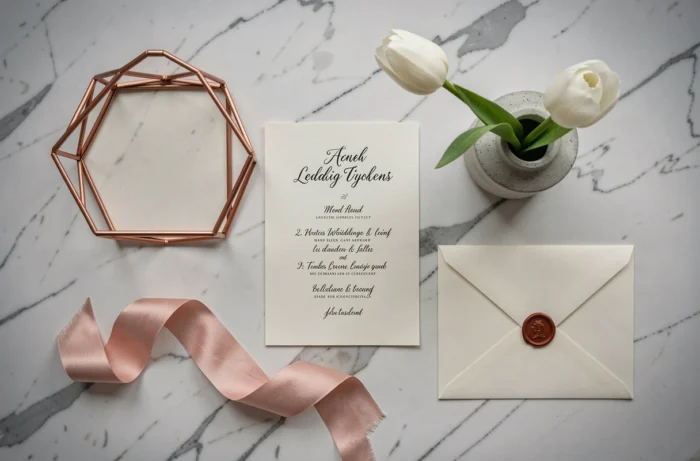
The distribution of the floral budget between visible and secondary areas makes all the difference. Investing in two or three striking arrangements is better than scattering small bouquets everywhere. A cocktail area without flowers but with candles and thrifted textiles remains more elegant than a space covered with half-filled mini-vases.