The Jacqueline cocktail is one of those drinks that we increasingly encounter at village festivals in the Southwest, outdoor weddings, and summer aperitifs among neighbors. Transitioning from a recipe for six people to a ten-liter batch isn’t just about multiplying the quantities by a coefficient: managing the cold, the sugar-acidity balance on a large scale, and the timing of preparation all change the game.
Sugar-acidity ratio: what changes when scaling up to ten liters
With a few glasses, an excess of grenadine syrup goes almost unnoticed. At ten liters, the same imbalance makes the drink cloying by the second glass. The basic principle remains simple (dry white wine, lemonade, grenadine syrup), but the syrup proportion must remain under strict control to avoid an overly sweet drink.
A tried-and-true formula for ten liters combines about five liters of dry white wine, four liters of lemonade, and one liter of grenadine syrup. Some versions increase the lemonade portion at the expense of the syrup. Feedback on this point varies: it all depends on the chosen wine and the brand of lemonade, whose sugar content varies significantly from one manufacturer to another.
Tasting the mixture before adding all the syrup allows for adjustments. Pouring two-thirds of the syrup, mixing, and then correcting in small doses remains the most reliable method when preparing a Jacqueline recipe for 10 liters for an aperitif intended for about twenty guests.
White wine for Jacqueline cocktail: which type to choose at this volume
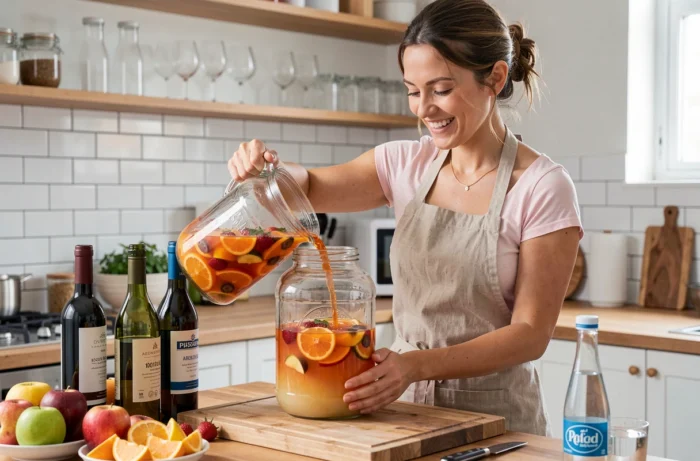
Dry white wine serves as the aromatic base of the cocktail. On a small scale, one opens a bottle without much thought. At ten liters, the choice of wine impacts both cost and taste much more visibly.
A dry and lightly oaked white wine works better than an aromatic or sweet wine. Neutral grape varieties like Ugni Blanc or Colombard, common in table wines from the Southwest, pair well with grenadine without creating aromatic conflict. An overly expressive Sauvignon may result in a bitter outcome once mixed with the syrup.
Budget also matters. For five liters of wine, a five-liter bag-in-box (BIB) offers a quality-price ratio that’s hard to beat. It can be resealed after opening, allowing for the mixture to be prepared in two stages if the main container isn’t large enough.
Temperature and service: keeping ten liters cool during an aperitif
The Jacqueline is best served very cold. For a small volume, a few ice cubes suffice. Ten liters pose a logistical problem that classic recipes never address: maintaining the drink between 6 and 10 degrees throughout the service.
Chill before mixing
The white wine and lemonade should be refrigerated separately the day before. Mixing liquids at room temperature and then trying to chill ten liters with ice cubes produces two undesirable effects: rapid dilution and insufficient temperature.
Container and ice
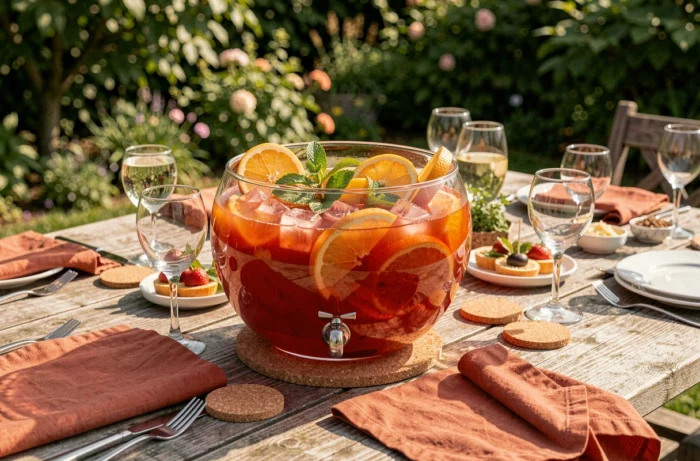
A large salad bowl, a glass carafe, or a stainless steel basin placed in a bed of crushed ice work well. The ice should surround the container, not float in the cocktail. A few points to check:
- Ensure there is a large enough basin to accommodate the container and the ice around it, not just underneath
- Add coarse salt to the ice to lower its melting temperature and prolong the cooling effect
- Keep the lemonade in the refrigerator and only add it at the last moment to preserve its fizz
- Cover the container between servings with a clean cloth to limit warming
The lemonade loses its bubbles in less than an hour in a large open volume. Adding half at the time of serving, then topping up midway through the aperitif, preserves the effervescence much longer.

How many guests for ten liters of Jacqueline
Recent guides for preparing large quantities of drinks converge on a practical estimate: plan for about 50 cl of drink per person for the duration of an aperitif, which is two to three glasses. Thus, ten liters of Jacqueline will cover an aperitif for about twenty guests under comfortable conditions.
This calculation assumes a classic aperitif duration (one to one and a half hours). For a longer evening or in hot weather, consumption increases. Planning for an extra one to two liters, or offering a non-alcoholic version alongside, helps avoid running short.
Non-alcoholic variant to expand service
Replacing the white wine with unsweetened white grape juice and adjusting the lemonade creates a non-alcoholic version that retains the fruity profile of the Jacqueline. Serving both versions side by side, clearly labeled, allows for accommodating all guests without multiplying recipes.
Jacqueline cocktail and summer aperitif trend in France
The Jacqueline is now mentioned in selections of cocktails that are popular in the summer in France, alongside spritz and mojito. This regional cocktail from the Southwest is gaining visibility well beyond its home region, driven by the search for easy-to-prepare drinks for groups.
Its main advantage for a festive aperitif remains its ease of implementation: three ingredients, no bar equipment, no technical skill required. At ten liters, the only real challenge is managing the cold and not drowning the mixture in sugar.
The next time you prepare a batch for an event, weigh your grenadine syrup instead of pouring it by eye. It’s the only gesture that separates a successful Jacqueline from a drink that’s too sweet for anyone to finish.