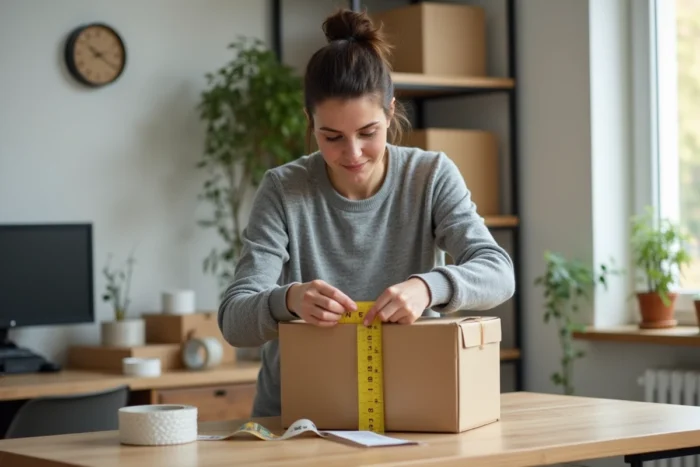
The size of a shipping box determines both the cost of shipping and the protection of the contents. An oversized package creates empty space, requires additional cushioning, and can increase the bill, especially on international shipments where dimensional weight comes into play. Conversely, a box that is too small compresses the product and weakens the walls under pressure.
Dimensional weight and pricing: the trap of oversized boxes
Most packaging guides emphasize the sturdiness of the box and the quality of the cushioning. They overlook a parameter that directly impacts the price: dimensional weight. For shipments to overseas territories and internationally, La Poste (like other carriers) can calculate a so-called “dimensional” weight based on the volume of the package, then charge based on the higher figure between the actual weight and this dimensional weight.
In practice, a large box filled with protective foam around a small lightweight item will be charged as if it weighed much more. Choosing the dimensions of boxes for La Poste as closely as possible to the product is therefore not just a matter of good logistical sense; it is a direct lever on shipping costs.
La Poste Solutions Business explicitly recommends packaging as closely as possible to the product to reduce delivery costs. This logic applies equally to e-commerce merchants who ship dozens of packages a day and to individuals sending a gift overseas.

Size and weight limits accepted by Colissimo and Chronopost
Before choosing a box, it is essential to know the constraints imposed by the selected shipping service. Colissimo and Chronopost each apply different maximum dimensions and weights, and an oversized package will simply be refused at drop-off.
Cumulative perimeter rule
The limit does not only concern length or width taken in isolation. Postal carriers generally use a formula that adds the largest dimension of the package to its cross-sectional perimeter. If the total exceeds the authorized threshold, the package is considered oversized, even if each side taken separately seems reasonable.
Checking this rule avoids an unpleasant surprise at the post office. An elongated box (tube, painting, curtain rod) quickly reaches the limit, while a cubic box of equivalent volume passes without difficulty.
Adapting the format to the chosen service
- For a standard shipment within mainland France via Colissimo, prefer a box whose dimensions remain well below the maximum thresholds to limit the additional cost related to size.
- For an express shipment via Chronopost, the weight and size limits may differ: check the specific conditions for this range before packing.
- For an international shipment or to overseas territories, dimensional weight adds to the size constraints, making the choice of box even more critical for the final price.
Fluting of the box and protection of the contents
Fluting refers to the wavy thickness located between the two flat faces of the box. It absorbs shocks and gives rigidity to the packaging. Not all shipping boxes offer the same fluting, and the choice depends on the weight and fragility of the item being shipped.
A single-flute box is suitable for lightweight and non-fragile items: clothing, books, textile accessories. For heavier or shock-sensitive products (ceramics, small appliances, glassware), a double-flute box offers significantly greater resistance to crushing and punctures.
Using a double flute on a lightweight package amounts to paying for unnecessary excess weight. Conversely, placing a heavy item in a single-flute box exposes it to crushing during transport. The suitability between the contents and the thickness of the box determines the survival of the product as much as the internal cushioning.
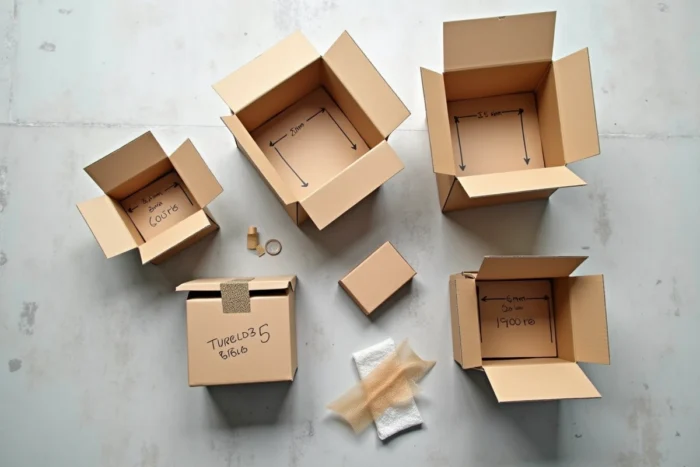
Method for determining the right dimensions of a shipping box
Rather than randomly choosing a box from stock, a methodical approach saves time and money.
Measure the packaged product, not the bare product
The classic mistake is to measure the item alone and then look for a box with identical dimensions. The cushioning (kraft paper, air cushions, foam) adds several centimeters on each side. Allow a cushioning margin of a few centimeters around the product to absorb shocks without compressing the contents.
Fill the residual void without oversizing
A well-chosen box leaves only a small space between the cushioned product and the walls. If the remaining void exceeds the width of a hand, the box is likely too large. It is better to go down a size and use thinner cushioning than to fill a large void with crumpled paper, which ends up compacting during transport.
- Measure the length, width, and height of the product protected by its cushioning.
- Add a reasonable margin on each axis for the filling material.
- Compare these dimensions to the available box sizes and choose the closest without being smaller.
- Ensure that the total (dimension + perimeter) remains within the limits of the chosen carrier.
Environmental obligations and choice of box
Packaging regulations are evolving due to the extended producer responsibility (EPR). ADEME oversees an observatory of EPR sectors, and the recent report confirms a strengthening of measures in favor of reuse and obligations for unique identifiers for those placing packaging on the market.
For an e-commerce merchant, this means that the choice of box goes beyond simple logistics. Reducing the size of the packaging decreases the amount of material used, thus lowering the eco-contributions paid to the eco-organization. A box tailored to the product generates less waste, costs less to ship, and reduces the EPR bill.
Individuals are not directly affected by these obligations, but they benefit indirectly from the movement: the ranges of boxes available at post offices or online are diversifying, with formats closer to the actual sizes of common objects. Choosing the right format has never been easier, provided you measure before packing.