
Online fashion is not just about browsing clothing catalogs on a screen. It’s an ecosystem where collections turn at an accelerated pace, where platforms impose their own codes, and where European regulations are beginning to reshape the rules of the game. Keeping up with online fashion trends requires understanding how these mechanisms work before filling a cart.
Online fashion regulations: what changes for shopping in France
Since September 2026, France has become the first country in the European Union to penalize fashion platforms based on the number of items offered on their site, rather than just their overall sales volume. This measure directly targets ultra-fast fashion players like Shein or Temu, whose catalogs contain hundreds of thousands of continuously renewed references.
Specifically, items sold on these high-volume platforms may be subject to specific environmental penalties. For buyers, this means a potential markup on certain low-priced items, which partially offsets their ecological impact.
At the same time, the European Union has initiated a crackdown on greenwashing in fashion. Since September 27, 2026, new rules require that any environmental claim be backed by verifiable evidence. Brands displaying labels like “eco-friendly” or “sustainable collection” on their product pages must now provide concrete proof. When you spot a new item presented as virtuous, check if the brand details its commitments or merely relies on a self-proclaimed label.
On Fashion Click, product pages allow you to compare pieces from different brands with direct access to manufacturing details, making it easier to sift through the multitude of claims.

Filtering fashion trends: reliable platforms and monitoring tools
The challenge is not finding information on trends, but separating the signal from the noise. Social networks, with Instagram and TikTok leading the way, remain powerful showcases for spotting emerging pieces. The problem: sponsored content is omnipresent, and a viral garment is not necessarily one that matches your style or body type.
Three criteria for evaluating an online fashion source
- Does the source distinguish between sponsored content and editorial reviews? An influencer who mentions a partnership is more reliable than an account that mixes advertising and recommendation without signaling it.
- Are the presented pieces placed in the context of a complete look, with indications of cut and material, or is it just a link to a product?
- Does the platform offer filters by style, budget, or type of clothing? A good fashion monitoring tool categorizes new arrivals, not just by algorithmic popularity.
Online magazines like Vogue or Elle continue to structure seasonal trends through their runway coverage. Their added value lies in analyzing style directions (cuts, palettes, materials) rather than promoting isolated products.
Building a personal style without following every micro-trend
Keeping up with all fashion news is like chasing a constant stream of proposals. Most viral micro-trends disappear within weeks. Betting on each of them leads to accumulating pieces that quickly go out of style, with a direct financial and environmental cost.
Distinguishing between enduring trends and passing fads requires a simple reflex. An enduring trend is recognized when it appears simultaneously across several brands positioned in different segments, from casual to high-end. A passing fad remains confined to one platform or a viral format.
Dresses, casual wear, statement pieces: choose your battles
Take the example of the dress: it is a piece that transcends all seasons with variations in cut and material. Investing in a dress that fits you well, made from sustainable fabric, is more relevant than giving in to a trendy but poorly fitting version.
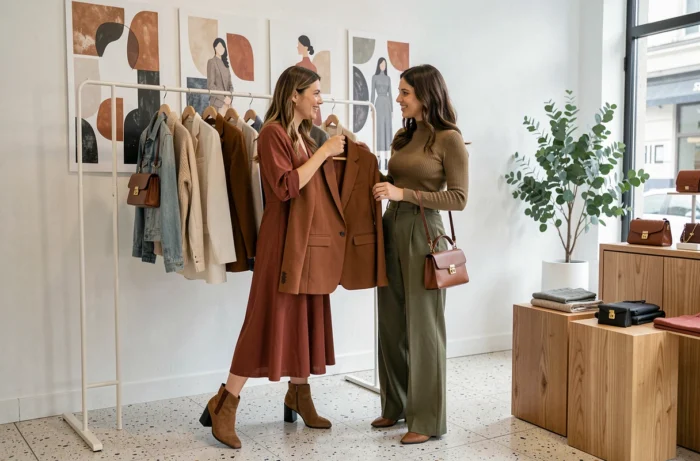
Apply the same logic to everyday casual wear. A good pair of jeans, a well-cut blazer, a t-shirt made of sufficiently dense cotton form a base that you can update with one or two trendy pieces each season. Three well-chosen pieces refresh a look better than ten impulsive purchases.
Smart online shopping: private sales, emerging brands, and traps to avoid
Private sales and promotional events from online brands create a calibrated sense of urgency to trigger purchases. Before confirming a discounted cart, check two concrete elements.
- Does the crossed-out price correspond to the actual price charged in the previous weeks? Some platforms inflate the reference price before a promotion to display a more attractive discount.
- Are the return conditions clearly stated? On high-volume marketplaces, return fees can negate the price advantage, especially since the new environmental penalties in France.
- Is the product composition detailed? A very low-priced piece made of unidentified synthetic material ages poorly and often ends up at the back of the closet after a few washes.
Emerging brands, often present on specialized platforms, offer women’s and men’s pieces with a clearer positioning on materials and manufacturing. Their more limited catalog makes choosing easier, provided you check customer reviews and actual delivery times.
Online fashion shopping is becoming clearer thanks to European regulatory oversight. Platforms that relied on volume and opacity are now directly targeted by these practices. For consumers, the best strategy remains to buy fewer, better-documented pieces, cross-referencing sources before each purchase.