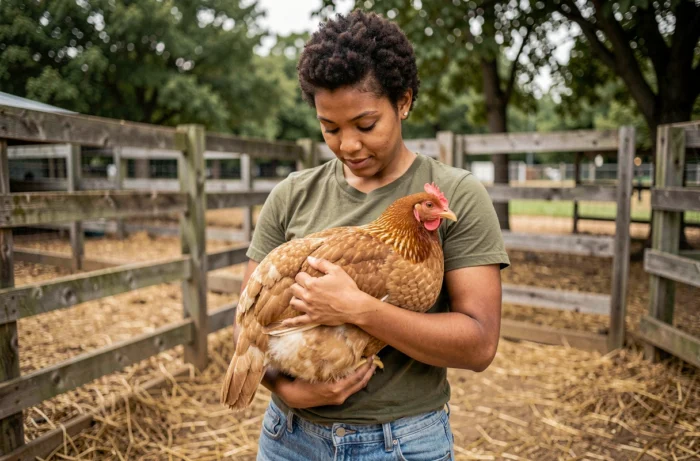
An animal suffers, yet the law treats it like a piece of furniture. Since 2015, Article 515-14 of the French Civil Code has described animals as “living beings endowed with sentience.” This recognition has not changed their legal status: subject to protective laws, they remain governed by the rules applicable to property. It is this gap between recognized sentience and unchanged legal status that gives the concept of animal liberation its full significance.
Sentience recognized, property status retained: the paradox of French law
Have you ever noticed that people talk about “animal protection” without ever talking about “rights” in the strict legal sense? The distinction matters. An animal recognized as sentient cannot bring legal proceedings. It cannot challenge the conditions in which it is kept or appeal a decision that affects it.
In practice, only approved associations can bring cases before the courts on behalf of animals. And these legal actions concern compliance with procedures, not recognition of a right belonging to the animal itself.
Associations sometimes succeed: on February 8, 2024, the Paris Administrative Court overturned ten authorizations for animal testing projects because the ethics committee that issued its opinion did not have the required approval. On June 26, 2025, the same court revoked the approvals of 17 ethics committees.
These decisions show that procedural safeguards sometimes protect animals more effectively than broad principles. When a committee is not properly approved, the project authorization is overturned. Administrative oversight works, but it depends on the vigilance of human actors, not on a right held by the animal. Detailed resources on this struggle are available at https://www.animal-liberation.net, which documents ongoing campaigns and progress made in several countries.
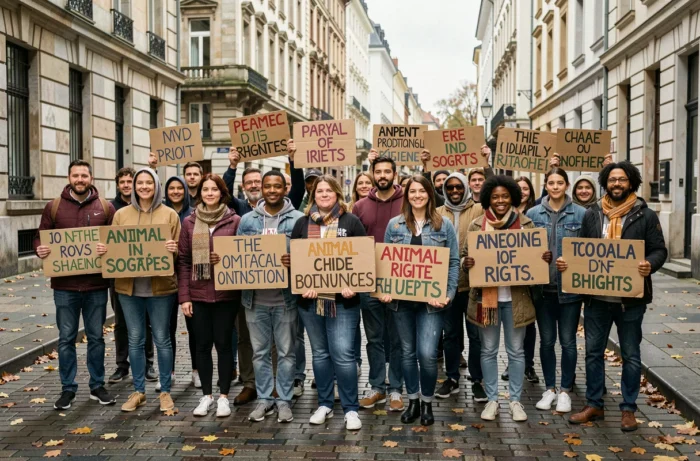
Peter Singer and the principle of equal consideration of interests
Australian philosopher Peter Singer published Animal Liberation in 1975. The book does not call for treating a pig like a human. It sets out a simpler principle: if a being can suffer, its interests deserve consideration.
Singer uses the term “speciesism” to describe favoring the interests of one species (our own) over those of another without sound moral justification. To illustrate the idea, consider a familiar example: refusing to kick a dog because it would suffer, while accepting that a pig can be kept in a space so small it cannot turn around. This difference in treatment is not based on a difference in the capacity to suffer, but on cultural habit.
What Singer does not say
The book does not advocate granting animals political rights. It does not call for cows to have the right to vote. Singer’s reasoning is utilitarian: the aim is to minimize total suffering across all species. This approach differs from another school of thought, represented by Tom Regan, who argues that animals have intrinsic rights, independent of any calculation of utility.
Two philosophies, one shared starting point: animal suffering exists, and the current legal system addresses it only through indirect mechanisms.
Animal testing: when regulation reveals its limits
The French Rural Code regulates animal testing through a strict process. Each project must be assessed by an ethics committee and then authorized. Procedures involving intense, prolonged suffering that cannot be alleviated are generally prohibited, except in exceptional cases where an exemption is granted. These provisions have been in force since December 6, 2024.
On paper, this framework seems robust. In practice, the rulings by the Paris Administrative Court show that projects have been authorized without meeting basic requirements. Ten authorizations overturned in February 2024, seventeen committees invalidated in June 2025: these figures do not describe a system with only occasional problems.
Why this gap? Because oversight depends on legal challenges brought by associations, which are lengthy and costly. An animal subjected to a painful procedure has no automatic mechanism to suspend it. The pace of the courts and the duration of suffering do not align.
What a genuine legal status could change
Granting animals a form of legal personhood would make it possible to appoint a permanent legal representative. Legal challenges would no longer depend solely on an association’s financial and logistical capacity. Several legal scholars are working on models of “animal personhood” suited to continental European law, but these proposals have not yet resulted in legislation in France.

Rethinking animal rights in everyday life: three practical levers
Animal liberation is not confined to the courts or philosophical treatises. It also involves individual and collective choices. Three areas account for most of the key issues.
- Food: reducing or eliminating consumption of products from intensive animal farming is the most direct way to reduce animal suffering on a large scale. Singer’s principle of equal consideration of interests finds its most immediate application here.
- Scientific research: supporting the development of alternative methods (cell cultures, computer modeling) can gradually reduce the use of sentient beings in experiments while maintaining rigorous scientific standards.
- The legal framework: urging lawmakers to go beyond simply recognizing sentience and create mechanisms for legal representation, so that animal protection no longer depends solely on the efforts of associations.
These three levers do not work in isolation. A widespread shift in eating habits creates economic pressure. Funding alternative research weakens the argument that animal testing is necessary. And a stronger legal framework makes the first two changes harder to reverse.
The question Singer raised in 1975 remains open: to value a being’s suffering is to accept that this value should have legal consequences. As long as French law continues to treat animals as property, recognition of their sentience remains a declaration without any enforcement mechanism.