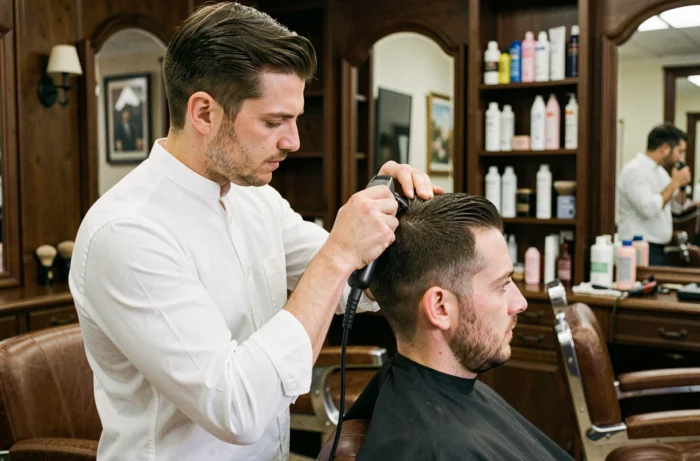
A man sits in the chair, shows a photo on his phone, and asks for a fade with volume on top. The barber complies. Result: the vertex appears sparser than before the cut, the spikes go in all directions, and the contrast between the shaved sides and the top gives the impression of a more thinning scalp.
The problem lies neither with the barber’s technique nor the reference photo, but with a mismatch between the actual density of the crown, the natural growth direction, and the requested style.
Vertex Density and Growth Direction: The Diagnosis No One Makes Before the Cut
Before choosing a length or type of fade, one should systematically observe two things on dry hair, without product. First, the actual density at the top of the head. Then, the direction in which the hair grows around the vertex (that famous swirl).
Most men skip this step. They arrive at the barber with a style idea but without checking if the hair on top can support that style. A fade that is too pronounced on the sides accentuates the weakness of the vertex by contrast. This is the most common trap: the skin fade draws attention to the area where hair is lacking the most.
To understand the men’s crown cut, one must think in terms of the natural break point. This point is the exact spot where the vertex swirl changes the direction of the strand. If the barber cuts without considering this, the hair will refuse to lay in the desired direction and will create a visible separation at the top.
Specifically, ask your barber to identify this break point before touching the scissors. It’s a thirty-second operation that radically changes the final result.

Men’s Crown Cut and Styling Errors: Matte Texture vs. Shiny Gel
The choice of finishing product sabotages more crown cuts than the cut itself. Many men still apply a shiny gel or a strong-hold product and then slick their hair back. On a thinning crown, this is the worst option.
The shiny gel clumps the strands together and exposes the scalp. The “wet” effect highlights every area where density decreases. In contrast, a matte texture product (volumizing powder, texturizing spray, matte fiber) separates the strands, creates apparent volume, and obscures the reading of actual density.
Styling Forward Rather Than Backward
Several recent guides recommend styling hair from the top forward rather than backward when the crown is visible. The principle is simple: bringing material to the front reduces the exposure of the vertex. A wide-tooth comb and a small amount of matte fiber are enough to achieve a natural finish.
The morning routine should include three steps:
- Blow-dry the hair with a warm dryer, directing the airflow forward to set the direction of the strand from the root.
- Apply a volumizing powder or matte fiber on top, in small amounts, working strand by strand with your fingertips.
- Check the result in the mirror under direct lighting (overhead light), because this angle reveals sparse areas in real conditions.
The matte textured finish remains the best ally for a fine crown. It adds body without weighing it down and avoids the “helmet” look produced by a classic gel.
Crown Cut and Face Morphology: Adapting the Fade to the Right Place
There is a lot of talk about face shapes (oval, square, elongated) when choosing a cut. For the crown, the reasoning is slightly different: one must think in terms of relative volume between the top and the sides.
On an elongated face, excessive volume on top accentuates verticality. Keeping more length on the temples and opting for a gradual fade (rather than a harsh fade) rebalances the proportions. A light taper is often more suitable than a skin fade for a long face.
On a round or square face, the sharper contrast between the short sides and the volume on top works better. One can afford a more pronounced fade because the goal is precisely to visually elongate the silhouette.
Length on Top: Neither Too Short Nor Too Long
The intermediate zone (neither shaved nor long enough to style) is a classic trap on the crown. The hair is too short to cover the vertex but too long to give a defined “crew cut” look. Opinions vary on this point, but it is often observed that it is better to choose a side:
- Very short all over (less than one centimeter), which gives a uniform and visually coherent result even with reduced density.
- Long enough to work with volume and direction using a texturizing product, which implies at least a few centimeters on top.
- Shaved head, a radical but perfectly clean option, especially when the crown is very visible and intermediate lengths do not yield convincing results.

Dialogue with the Barber: Information to Provide for a Successful Crown Cut
Showing a photo is not enough. A photo does not provide information about density, hair thickness, or the growth direction of the person in the chair. You need to indicate to the barber the desired styling direction before he starts.
Three points to communicate clearly:
First, specify whether you style forward, to the side, or backward on a daily basis. The fade and lengths must be calibrated according to this direction. Next, point out recurring spikes. A spike at the vertex changes the cutting strategy, and a good barber can work with it rather than against it. Finally, discuss your product routine. If you don’t use anything in the morning, a cut that requires daily styling won’t hold.
The result of a crown cut depends as much on the prior dialogue as on the technical gesture. A barber informed about your density and styling habits will adapt the fade, length, and transition line so that the result works daily, not just when leaving the salon.