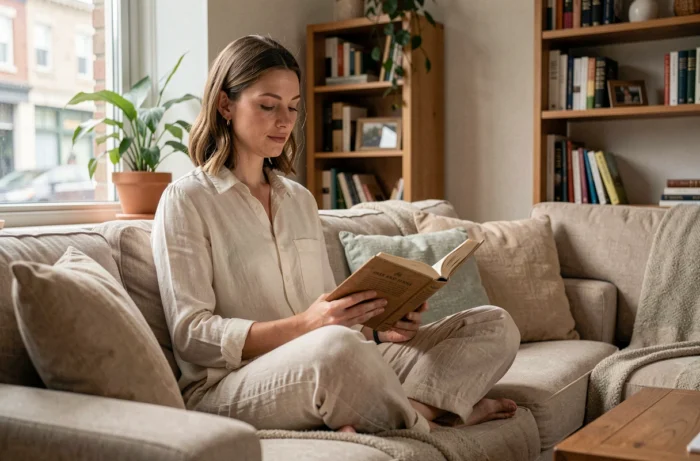
A single woman renting an apartment alone, without family or husband, does she transgress a religious prohibition? This question regularly arises in forums, discussion circles, and Islamic legal consultations. Living alone as a single woman raises legitimate questions at the intersection of religious law, social tradition, and contemporary realities.
Housing security and Islamic law: the distinction that texts really make
In the Muslim legal tradition, the prohibition does not pertain to living alone per se. What the texts address is the risk: dangerous isolation, proximity to a non-mahram man (the notion of khalwa), or solitary travel without safety conditions.
Several recent fatwas clarify this distinction. They clearly separate risky isolation from living alone in a secure environment. The presence of neighbors, a safe neighborhood, access to reliable transportation: these contemporary criteria are integrated into legal analysis.
Zakariyâ al-Ansârî, a Shafi’i jurist, formulated a principle echoed in several opinions: a mature and rational woman can reside wherever she wishes, provided she does not fear for her safety. This principle is still referenced in contemporary fiqh.
The nuance lies in a specific point: it is not the solitude of the housing that poses a problem, but the quality of the environment. An apartment with known neighbors, a monitored building, or a quiet neighborhood meets the safety conditions expected by the religious rules for single women in most legal schools.
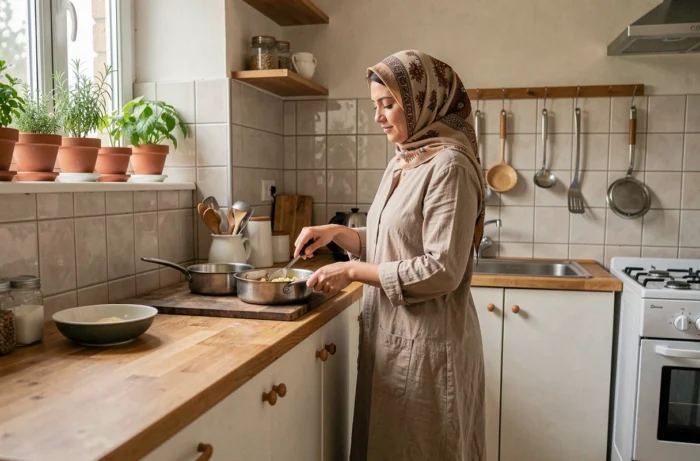
Khalwa and safar: two concepts often confused with living alone
Why does this confusion persist? Because two distinct prohibitions are regularly mixed with the question of autonomous housing.
Khalwa, or isolation with a non-related man
Khalwa refers to being alone in a closed space with a man who is neither a husband nor a mahram (close relative with whom marriage is prohibited). This prohibition aims to prevent situations of temptation or breaches of modesty.
Living alone in one’s own housing does not constitute khalwa. As long as no unrelated man shares this private space in isolation, the situation does not fall under this prohibition.
Safar, or travel without accompaniment
Safar refers to traveling a long distance without a mahram. Several legal schools have relaxed this rule for group travel with trustworthy women or in modern transportation conditions deemed safe (plane, train, organized convoy).
The key point to remember: living alone and traveling alone are two distinct legal situations. The fact that solitary travel is regulated does not mean that autonomous housing is similarly regulated.
Living alone as a single woman: what other religious traditions say
The subject is not exclusive to Islam. Other religious traditions have addressed the issue of female celibacy and residential autonomy, sometimes from very different angles.
- In Catholicism, consecrated celibacy (religious, consecrated laity) is valued as a spiritual choice. Canon law imposes no prohibition on a single laywoman living alone.
- In Judaism, Talmudic tradition encourages family and community life, but no formal prohibition applies to the autonomous housing of a single woman. The pressure is more social than legal.
- In several Protestant denominations, individual autonomy is seen as a personal responsibility before God. The choice of residence falls under free will.
This overview shows that the question of women’s autonomous housing is more social than theological in most traditions. Foundational religious texts rarely regulate the place of residence as such.
Social pressure and religious interpretation: untangling the two
In many families, the reluctance to see a daughter leave the parental home before marriage does not rest on a specific religious text. It is based on a cultural norm passed down through generations.
This blend of family tradition and religious prescription creates confusion. A woman wishing to move out for professional reasons, to escape a difficult family environment, or simply to gain independence sometimes faces a discourse that presents her choice as sinful, without a solid legal basis.
Several contemporary scholars remind us that chosen celibacy is a legitimate life path in Islam. Recent texts revalue this option, breaking with certain discourses that still equate female celibacy with failure or deviation.

Concrete conditions to check before moving out alone
For a single Muslim woman considering autonomous housing, the criteria put forth by contemporary jurists can be summarized in a few practical points:
- The safety of the neighborhood and building (known neighbors, controlled access, adequate lighting)
- The absence of regular khalwa situations (no cohabitation with a non-mahram man)
- The maintenance of family ties, even at a distance (visits, calls, presence at important occasions)
- The ability to meet her needs independently
These conditions are not insurmountable obstacles. They reflect a common-sense framework shared by most traditions, religious or otherwise.
Autonomous living and religious practice: a de facto compatibility
Living alone does not mean living cut off from one’s community or spiritual practice. Prayer, fasting, attending the mosque or church, and community engagement: all of this is not only possible but sometimes facilitated by a well-managed personal living environment.
Residential autonomy is not a renunciation of faith. It is a living environment that, when it respects principles of safety and dignity, remains fully compatible with sincere religious practice.
The true criterion, across traditions and eras, remains the same: the quality of the environment and the intention guiding the choice. A single woman living alone in a safe housing, while maintaining her family ties and practice, does not contravene any foundational text. The confusion between social norm and religious prescription deserves to be clearly addressed, so that every woman can make an informed choice.