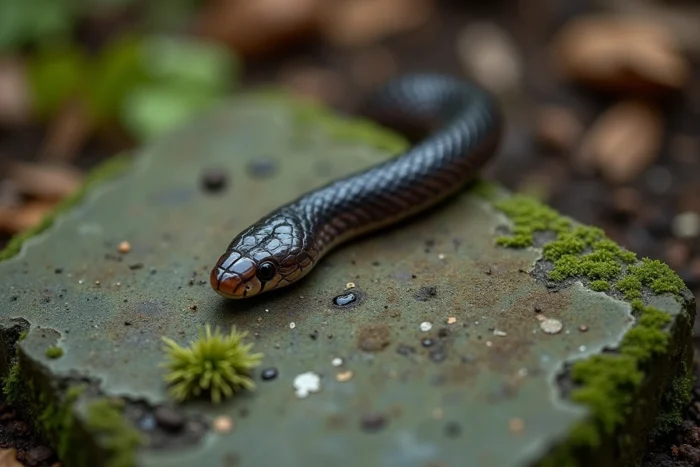
You found a small dark pile at the foot of the wall or near the compost, and you don’t know which animal left it there. Snake droppings often go unnoticed or are confused with those of other nocturnal visitors. Knowing how to identify them helps you better understand what lives in your garden, without unnecessary panic.
Snake droppings near the compost: confusing them with those of hedgehogs or foxes
Have you ever noticed that the same corner of the garden attracts several animals? The compost heap, the underside of a hedge, or the edge of a wall are shared passage areas. Finding droppings in these places is not enough to identify the culprit.
Snake droppings have an elongated, often irregular shape, with an end that is sometimes whitish. This white part corresponds to uric acid, the equivalent of urine in reptiles. This is the first visual clue to look for: mammals do not have this chalky deposit.
A hedgehog’s droppings are cylindrical, compact, and contain shiny fragments of insect elytra, visible to the naked eye. Those of a fox are larger, often deposited in a high place (on a stone, a stump), and emit a very pronounced musky odor. Snake droppings, on the other hand, smell little or not at all.
To know how to reliably recognize snake droppings, you need to cross-reference three criteria: size (modest, a few centimeters), the presence of uric acid, and visible content.
- Snake droppings: elongated, small, whitish end, sometimes contains hairs or scales from prey, almost odorless.
- Hedgehog droppings: cylindrical and black, shiny, filled with fragments of insects (ground beetles, beetles), often on a short lawn.
- Fox droppings: larger, twisted, deposited prominently on a raised point, strong musky odor, may contain seeds or feathers.

Composition of snake droppings: reading the diet of your garden
When observing snake droppings up close, you find undigested remains. Hairs from voles, fragments of lizard scales, sometimes feathers from small songbirds. Each dropping tells the story of a specific meal, and this meal informs you about the wildlife present around your home.
A grass snake, for example, primarily consumes amphibians: frogs, toads, newts. If you find its droppings near a water source, it’s a sign that the prey-predator cycle is functioning in your garden. The green and yellow snake, on the other hand, hunts more lizards and small mammals.
This reading of the composition goes beyond simple identification. It transforms a mundane dropping into a concrete indicator of biodiversity. A garden that hosts a snake also shelters its prey, which in turn depend on insects, plants, and moisture. The dropping signals an entire active food chain.
Bundle of clues in the garden: droppings, molts, and rodent burrows
Finding a single dropping does not prove that a snake lives in your garden. Snakes move over large distances and can cross a garden without settling in. To confirm regular presence, you need to look for other signs.
A translucent molt caught on a bush or a wall is the most telling sign. Snakes shed several times a year, and the skin comes off in one piece when conditions are right. The molt also helps estimate the size of the animal.
Holes in the ground also deserve careful attention. Snakes do not dig themselves. They reuse vole tunnels, cracks in a wall, or cavities under a pile of wood. A clean hole a few centimeters in diameter, located near a shelter (flat stone, board laid on the ground), can serve as a temporary refuge.
- Complete or partial molt found on low vegetation or at the foot of a wall.
- Old rodent burrow with a smooth entrance, without freshly disturbed soil (an active rodent pushes soil around the hole).
- Droppings with uric acid deposit, found near a water source, compost, or a pile of stones.
This bundle of clues converges towards a lasting presence. A single isolated sign is insufficient to conclude.
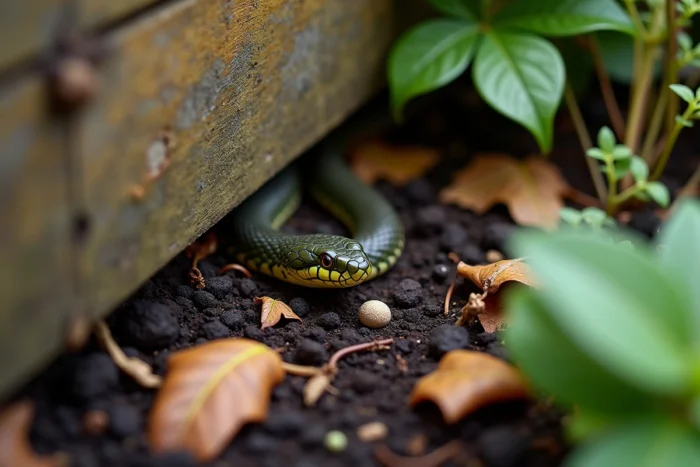
Snake in the garden: protect without intervening
The snake is a protected reptile by law in France. Capturing, moving, or killing it exposes you to penalties. This is not a matter of choice: it is the current regulatory framework.
In practice, the snake poses no danger to humans. It is not venomous, it flees at the slightest noise, and only bites very rarely, as a last resort. Its presence naturally regulates populations of rodents and slugs, two of the main pests in the vegetable garden.
If you find a suspicious hole or droppings that you cannot identify, the best approach is to photograph from a distance and contact a local naturalist association. These organizations identify the species from a photo and advise you free of charge.
Keeping a corner of the garden a bit wild (wood piles, stacked stones, tall grasses) encourages the presence of snakes. It also attracts hedgehogs, slow worms, and ground beetles. A garden where the snake finds its place is a garden that functions ecologically.
The reflex when faced with unidentified droppings should not be worry, but curiosity. This small dark deposit at the foot of the wall confirms that your garden hosts an active, discreet, and useful wildlife.