
Fleece and cashmere do not play in the same technical category. Comparing these two fabrics solely based on warmth ignores their behavior in relation to moisture, wind resistance, and structural durability. To choose between fleece and cashmere this winter, one must think in terms of usage context, not perceived comfort in-store.
Thermal conductivity and air trapping: what truly separates fleece and cashmere
The insulation mechanism of a textile relies on its ability to trap still air between its fibers. Cashmere excels in this regard: its ultra-fine fibers create a dense network of micro-pockets of air that significantly slow down heat transfer. At equal thickness, cashmere insulates better than most synthetic fibers.
Polyester fleece uses a similar principle, but with a more open structure. Its fluffy texture effectively traps air in static conditions. The problem arises as soon as wind comes into play: the air permeability of standard fleece is significantly higher than that of tightly knitted cashmere. Without a windbreaker on top, fleece loses a significant part of its insulating power.
We find that public comparisons often overlook this variable. A cashmere sweater worn alone under a windbreaker offers superior thermal insulation compared to a fleece of equivalent weight in the same configuration. On the other hand, when hiking with technical layering, fleece regains the advantage due to its moisture management.
As detailed by the Rev Mode site and the warmth of fabrics, the breathability of fleece allows it to dry much faster than cashmere after exposure to sweat or rain.

Wet fleece vs. wet cashmere: behavior in real conditions
Fleece retains some of its insulating properties even when wet, which is its clearest technical advantage. Polyester hardly absorbs water: moisture passes through the structure without settling, and drying occurs quickly.
Cashmere, an animal keratin fiber, absorbs moisture into its internal structure. A soaked cashmere sweater temporarily loses a large part of its insulating power and takes several hours to dry at room temperature. For urban use without prolonged exposure to rain, this remains a minor drawback. For sustained outdoor activity, it is a deal-breaker.
When fleece dominates
- Sports or outdoor activities where sweating is significant: fleece wicks moisture without losing its thermal capacity
- Unstable weather conditions with alternating rain and calm: the reduced drying time prevents cooling effects
- Worn as a mid-layer in a three-layer system (technical base, fleece, waterproof shell)
When cashmere is essential
- Daily use in urban settings, under a windproof coat: the warmth-to-weight ratio is unbeatable
- Unevenly heated indoor environments (offices, transport): the natural thermoregulation of cashmere prevents overheating
- Travel where luggage volume matters: a cashmere sweater takes up less space than a fleece with comparable insulation
Durability and maintenance: the real cost over several winters
The purchase price of cashmere is significantly higher than that of fleece, but reasoning based on a single winter skews the analysis. A good quality cashmere, properly maintained (hand washing, flat drying), retains its insulating properties and feel for many years. Pilling, often cited as a flaw, can be controlled with a cashmere comb and decreases after the first washes.
Fleece degrades differently. After several dozen washes, the fiber structure flattens and the insulating power decreases. A fleece gradually loses its ability to trap air over washing cycles, while well-treated cashmere maintains its performance.
However, fleece maintenance is simpler: machine wash at low temperature, quick drying. For a garment subjected to intensive and frequent use (sports, outdoor work), the ease of fleece maintenance compensates for its shorter lifespan.
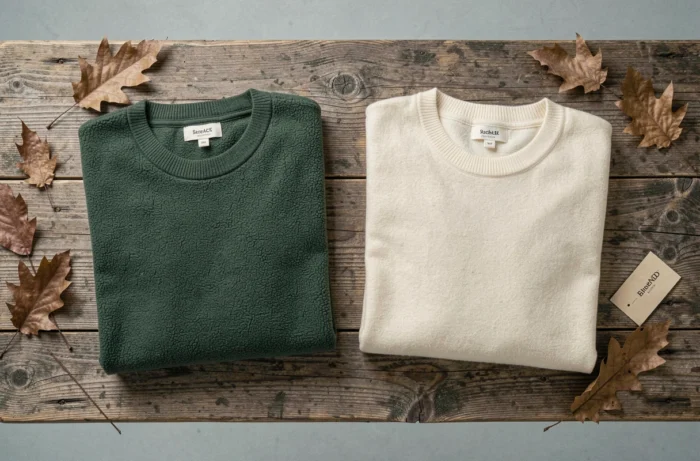
Environmental impact: synthetic microfibers vs. pressure on pastures
Both materials pose distinct environmental issues, and neither emerges unscathed from the analysis. Fleece, even when made from recycled polyester, releases plastic microfibers with every machine wash. The use of filtering laundry bags reduces this dispersion without completely eliminating it.
Cashmere, on the other hand, is linked to increasing pressure on grazing ecosystems. The rise in goat herds, particularly in Mongolia, has contributed to the degradation of certain pastures. Global demand for cashmere amplifies this phenomenon, and traceability labels remain inconsistent across supply chains.
Comparing the environmental footprint of the two materials requires considering the complete cycle: production, transport, number of washes over the garment’s lifespan, and end of life. Well-maintained sustainable cashmere amortizes its impact over a decade, while fleece replaced every two or three winters accumulates production cycles and microfiber emissions.
The choice between fleece and cashmere to face the cold this winter depends less on an absolute ranking of warmth than on the context of use. For urban daily life where thermal comfort and longevity matter, cashmere remains the most relevant fabric. For outdoor activities with exposure to moisture, technical fleece has no equivalent in its price range. Mixing the two in your wardrobe, depending on the situations, remains the most rational strategy.