A Polaroid photo takes several dozen minutes to reveal its final colors. During this time, the chemistry trapped between the layers of the print remains vulnerable to light, heat, and handling. Understanding what happens during this phase helps avoid the most common defects: waves in the image, washed-out hues, irreversible spots.
Temperature and light at the moment of ejection: two variables that change everything
Most guides focus on what to do after ejection. However, the most determining factor comes into play right at the moment the print exits, sometimes within the first second.
In bright sunlight or high heat, the layer of chemical reagents reacts too quickly and unevenly. Recent user testimonials show that a photo left facing the sun immediately after ejection can develop a purple haze or overexposed areas that are impossible to correct.
Conversely, in cold weather, the chemical reaction slows down significantly. The photo then appears dull or incomplete for long minutes, prompting some users to shake it or warm it up too abruptly.
| Condition | Main Risk | Appropriate Action |
|---|---|---|
| High heat, direct sunlight | Too rapid chemical reaction, colored haze, washed-out hues | Place the photo in a cool, shaded area (cooler bag, air-conditioned room) |
| Cold (below the comfort range of the film) | Incomplete development, dull colors | Slip the photo into an inner pocket of a jacket, close to the body |
| Moderate ambient temperature, indirect light | Low | Lay the photo face down on a flat surface |
When it’s cold, keeping the print against your body, in an inner pocket of a jacket, maintains the chemistry within a favorable temperature range without causing thermal shock. In high heat, a soft cooler bag (without direct contact with ice) provides a stable micro-environment until the reaction is complete.
To properly dry a Polaroid photo, the most reliable reflex is to turn it face down immediately after ejection to protect the sensitive surface from any direct light source.
Shaking a Polaroid print: why this action damages the chemistry
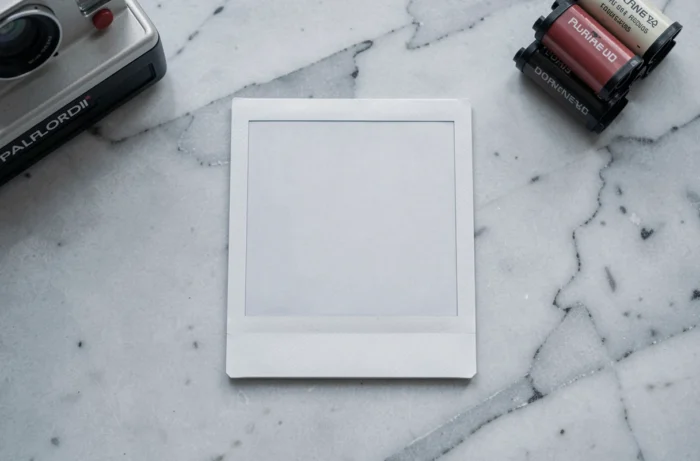
Églantine Aubry, a specialized photographer and former member of the Impossible Project in Paris, explains it clearly: shaking a Polaroid print is completely useless on modern films. The action causes a mechanical twist of the photo, creates waves in the layer of reagents, and leads to poor distribution of the chemistry across the film.
This habit dates back to the 1950s. The first Polaroid cameras ejected photos into small black envelopes. Once the envelope was removed, the print was sticky and wet: shaking it did indeed speed up the drying of the surface. This process was abandoned in the mid-1960s when Polaroid developed a waste-free integral system, notably at the request of Mrs. Johnson, the First Lady of the United States, concerned about pollution in public parks.
Since then, the development chemistry is sealed between two layers and requires no external intervention. Shaking, blowing on it, or touching the surface during development can only degrade the result.
Frog tongue accessory and camera orientation: protect the photo right from the start
Some recent Polaroid cameras include an opaque flap called frog tongue that automatically covers the print at the moment of ejection. This small flap protects the photosensitive surface from light during the first few seconds, which are the most critical for the final quality of the image.
On models that do not have it, advanced users recommend turning the camera immediately after ejection so that the photo comes out already oriented face down, sheltered from the main light source.
- Check if the camera has an integrated frog tongue (present on several recent Polaroid models) and ensure it is not bent or stuck.
- Without a frog tongue, immediately cover the print with your hand or an opaque cardboard, then turn it face down.
- Never place the photo on a hot surface (dashboard, metal in the sun) during the development phase.
- Avoid any contact with fingers on the image area until the print has reached its final colors.
Storage after drying: humidity and light in the long term
Once development is complete, the print remains sensitive to storage conditions. High humidity softens the layers of the print and can cause delamination or mold over several months.
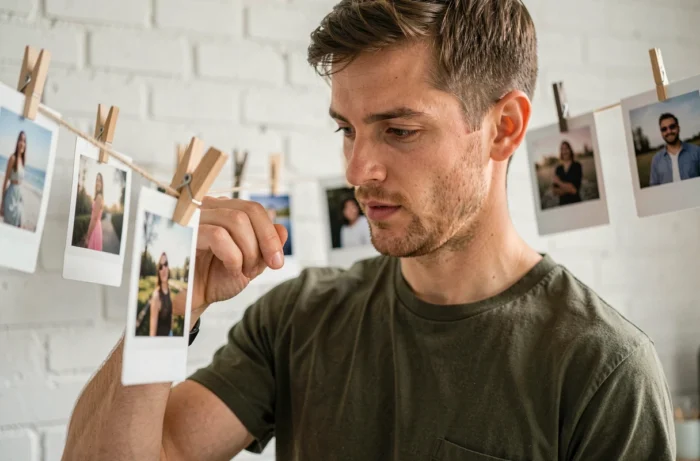
For long-term storage, prints should be kept flat, in a dry place, and away from direct light. An album with acid-free polypropylene sleeves provides adequate protection against UV and dust.
Photographic conservation standards recommend maintaining a stable temperature and moderate relative humidity. Abrupt variations (unheated room in winter then overheated in summer) accelerate the degradation of pigments. A stable environment matters more than a low temperature.
Common storage mistakes
Sticking a Polaroid print with regular tape leaves an acidic residue that yellows the white border within a few months. Refrigerator magnets exert constant pressure on the surface and can leave a permanent mark. Stacking prints face to face without interleaving sometimes causes a transfer of residual chemistry between images.
The drying of a Polaroid print relies on a simple principle: the less you intervene, the better the result. Protecting the photo from light immediately after ejection, adapting the action to the ambient temperature, and resisting the urge to shake the print are enough to achieve true colors and uniform development.